What makes a lightweight cotton comforter light, and how do you choose one?
Updated .
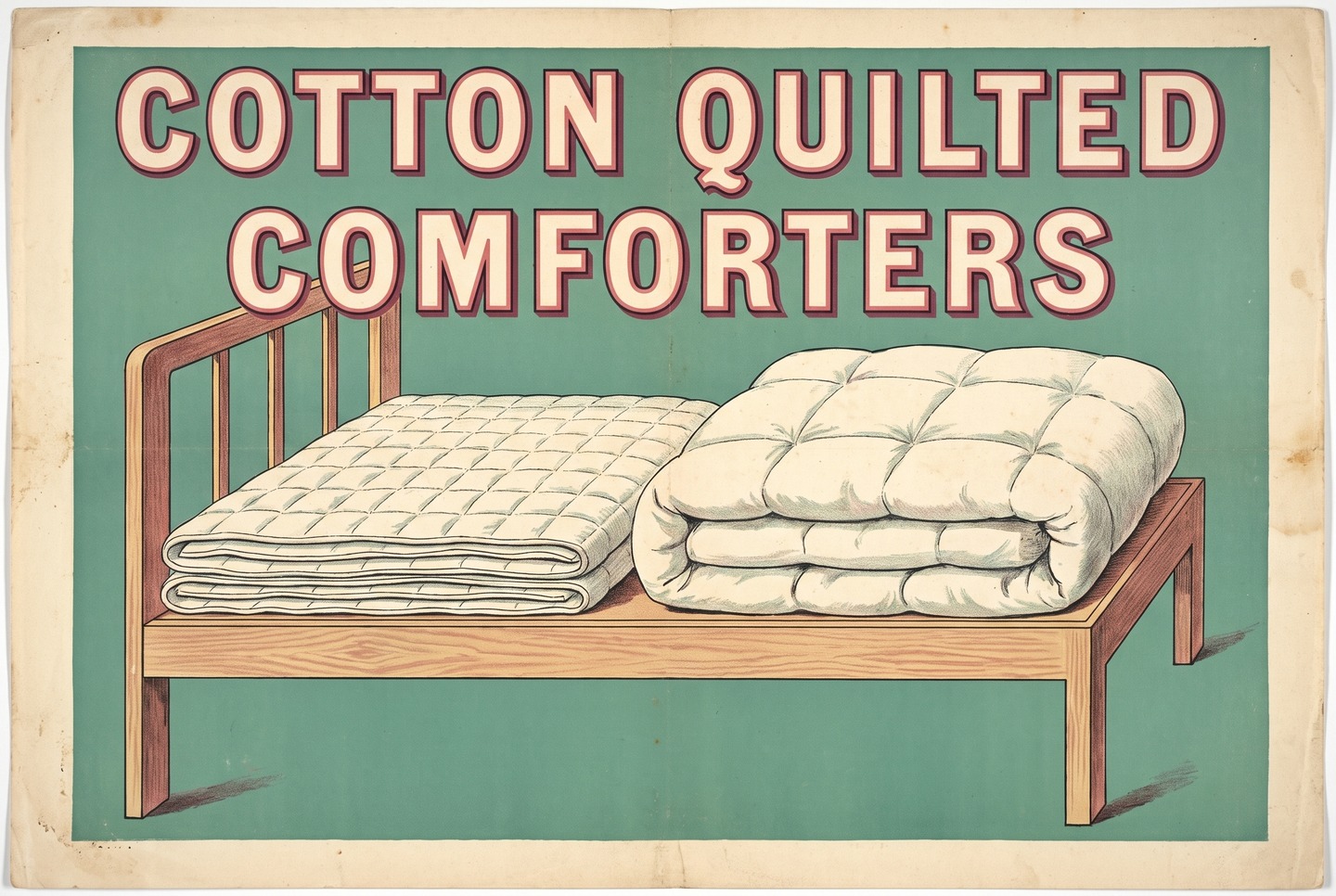
A lightweight cotton comforter makes two promises to you. It stays cool, and it has cotton in it. You can check both on the product page if you know which lines to read.
Short answer: A lightweight cotton comforter is light because it holds less fill. The cotton has nothing to do with it. On the down pages we read, a lightweight queen held 29 to 38 ounces of down in a cotton shell (The Company Store; Luxury Egyptian Linens). Cotton fill is sold by GSM instead, and one 240 GSM full/queen is listed at 6.3 lbs in all (Natural Linens). Only compare ounces between comforters with the same fill, and read the fill line before the shell.
This guide is for: people in the United States who want a thinner comforter with cotton in it and need to compare product pages that describe it in different ways.
Key Takeaways
- Fill weight sets the warmth. The lightweight down pages we read put 29 to 38 ounces in a queen. One seller puts 25 oz of fill in its queen summer weight and 30 oz in its regular weight (Canadian Down & Feather).
- Cotton fill is listed a different way. Natural Linens gives its 240 GSM cotton-filled full/queen as 6.3 lbs in total, not as ounces of fill (Natural Linens). A number of ounces only tells you something when the fill is the same.
- "Egyptian cotton" needs proof. The Cotton Egypt Association, which licenses the trademark and certifies suppliers, estimates that some 90% of products labeled Egyptian cotton are inauthentic (Retail Dive).
On This Page
What does "lightweight" mean on a cotton comforter?
It means less fill, not a different fabric. The word is a warmth level set by each seller, and no US rule defines how light it must be.
Sellers use lightweight as a warmth tier, and each store decides where the tier starts. The Company Store sells one organic cotton down comforter in four warmth levels: Light, Medium Warmth, Extra Warmth, and Ultra Warmth (The Company Store). The shell you touch stays the same. Only the amount of down inside changes. Canadian Down & Feather describes the same method: to make a comforter warmer, it adds ounces of fill (Canadian Down & Feather).
So the word tells you which way the comforter leans. It doesn't say by how much. You can't compare one store's lightweight with another's until you see a figure. The figure you want is the fill weight in ounces for your bed size. Without it, you are comparing adjectives.
US labeling rules won't settle this. FTC guidance says that when fillings are added for warmth, their fiber must be disclosed (FTC). That tells you the fill's fiber. It does not set an amount, and it does not define light. So you have two separate checks to make: the fiber line and the ounce figure.
If the words shell, fill and insert still blur together for you, our page on what a cotton duvet is explains them. In this guide, a comforter means one quilted piece with its fill sewn in.
How many ounces of fill make a comforter lightweight?
On the down pages we read, a lightweight queen held 29 to 38 ounces of fill. Cotton fill is usually listed by GSM or total weight instead.
Sellers publish these figures for their lighter cotton-shell comforters. One row is filled with cotton.
| Seller's page | Size | Fill | Fill weight | Fill power |
|---|---|---|---|---|
| The Company Store, Light | Queen | White down | 29 oz | 600 |
| Egyptian Linens, Light-Medium | Full/Queen, 90 x 90 in | White goose down | 33 oz | 600 |
| Egyptian Linens, Lightweight | Full/Queen, 90 x 90 in | White duck down | 36 oz | Not confirmed on the page |
| Luxury Egyptian Linens, Lightweight | Full/Queen, 90 x 90 in | Goose down | 38 oz | Not on the page we read |
| Canadian Down & Feather, Summer | Queen | White goose down | 25 oz | Not in the guide we read |
| Natural Linens, 240 GSM | Full/Queen, 90 x 92 in | Organic cotton | Not stated; 6.3 lbs total | Does not apply |
Across the four pages labeled light or lightweight, you will see fill from 29 to 38 ounces.
Fill power changes what each ounce does. IDFL, a down testing lab, says a product labeled 650 fill power means 30 grams of material will fill 650 cubic inches (IDFL). Higher numbers give you more height per ounce.
Cotton fill works differently. Natural Linens lists its full/queen at 90 by 92 inches and 6.3 lbs (Natural Linens). That total includes the shell, so you can't read it as fill alone. GSM means grams per square meter, and 240 GSM is about 7 oz per square yard. You can't set it beside a down comforter's fill ounces. Compare cotton with cotton.
Is the cotton on the outside, the inside, or both?
Often only the outside. Many comforters sold as cotton pair a cotton shell with down, feathers or polyester, so read the fill line first.
The shell is the fabric you touch. The fill line tells you what sits inside it. Puredown lists the fill of its lightweight organic cotton comforter as 80% goose feather fibers, 15% goose feathers and 5% down fibers, inside an organic cotton shell (Puredown). That is cotton outside and feathers inside. Egyptian Linens' dobby version pairs an Egyptian cotton shell with 75% Down and 25% Feather (Egyptian Linens).
All-cotton comforters exist. You have to go looking. Crane & Canopy notes that most down alternative comforters are polyester-based and says its own is all cotton (Crane & Canopy). Whisper Organics pairs a soft 300 thread count organic cotton shell with 240 GSM organic cotton fill (Whisper Organics).
We cover this split in more detail in Is a 100% cotton comforter cotton inside, too? and, for certified fiber, in Is an organic cotton comforter organic on the inside?. The table below is our own judgement, drawn from the pages in this guide.
| Fill inside the cotton shell | How the page shows lightness | Our judgement |
|---|---|---|
| Down | Ounces, often with fill power | Easiest to compare, because both numbers are usually given |
| Down and feather blend | Percentages, ounces often missing | Feathers test lower in fill power, so ask for ounces |
| Cotton batting | GSM or total weight, if anything | Pick it for an all-cotton bed, not to save weight |
| Polyester | Often sold as "down alternative" | Check whether "cotton" in the title means only the shell |
Does an Egyptian cotton shell make a down comforter lighter?
No. An Egyptian cotton shell changes how the surface feels. The ounces of down inside set the warmth, and the page states them separately.
The phrase Egyptian cotton lightweight down comforter joins two separate claims. One is about where the shell fiber grew. The other is about how much down is inside. Neither proves the other. You need to check each one on the page.
Take one listing as an example. Egyptian Linens' lightweight model lists a 100% Egyptian cotton shell, white duck down fill, and a warmth level of Medium, All Season (Egyptian Linens). The product name says lightweight. The warmth line says medium, which you would miss if you stopped reading at the title.
Bed size matters as well. On the same page, King/Calking measures 106-inch X 90-inch filled with 40 Ounces of Down, 4 ounces more than the full/queen, because it covers more bed (Egyptian Linens). The Company Store's light tier goes up by size too: Twin 20oz, Full 25oz, Queen 29oz (The Company Store). Compare fill weight at your own bed size, never across sizes.
The shell does have a job in a down comforter: it has to hold the down in. Egyptian Linens describes a shell crafted from 100% hypoallergenic down-proof cotton (Egyptian Linens). But the shell cannot make a heavy fill feel light. Less warmth means fewer ounces.
How do you check an Egyptian cotton claim before you buy?
Look for a named Giza variety and the Cotton Egypt Association seal. The words Egyptian cotton alone prove nothing about where the fiber grew.
Treat Egyptian cotton as a claim you still need to check. The Cotton Egypt Association, which licenses the trademark and certifies suppliers, estimates that some 90% of products labeled Egyptian cotton are inauthentic (Retail Dive). The same report points out that the phrase says where the fiber grew, not what type of cotton it is. Cotton With Love gives plain advice: if a brand doesn't mention the association's certification, you should treat the claim as unverified (Cotton With Love).
You pay for real Egyptian cotton because of its long fibers. Egypt's growing conditions produce fiber lengths that can exceed 1.4 inches (36 mm) in the finest varieties (Cotton With Love).
Six of the 12 pages in our count below used the words Egyptian cotton. None of the 6 mentioned the Cotton Egypt Association in the text we read. 2 said Giza without a variety number. The other 4 said Egyptian cotton and nothing more.
| What the page says | What it tells you | What to ask the seller |
|---|---|---|
| "Egyptian cotton" alone | An origin claim with no evidence | Which Giza variety, and who certified it? |
| "Giza cotton" with no number | A place name, not a variety | Ask for the variety number |
| A named variety, such as Giza 45 | A specific, checkable claim | Ask for a licence or seal |
| A very high thread count | Nothing about origin | Ask whether the yarn is single-ply |
What bedroom temperature suits a lightweight comforter?
Sleep advice often says 60 to 67°F, but many bedrooms run warmer at night. A lightweight comforter suits warm rooms and people who feel warm in bed.
Common advice favors a cool room. Cleveland Clinic quotes a sleep psychologist who tells you to keep your bedroom at 60 to 67° F (15 to 19° C) (Cleveland Clinic). In a room that cool, many people want more than a light comforter. In our judgement, a lightweight comforter earns its place when your room stays warmer than that range overnight.
Warm bedrooms are more common than you might think. In one Los Angeles study, nighttime indoor apparent temperature ranged from 26 to 35 °C and averaged 5 °C higher than outdoors (Los Angeles cohort study). That works out to 79 to 95°F, averaging about 9°F above the outdoor reading. If your home has no air conditioning, your room may be one of them.
Night heat matters for more than comfort. An Australian study monitored 47 adults aged 65 and over through one summer, and bedroom temperatures above 24 °C (75 °F) were linked with higher heart rates and other signs of stress (Queensland study). The authors note that World Health Organization guidance caps daytime indoor temperature at 26 °C (79 °F), with no matching figure for night.
Your own room is the real test. If it cools sharply toward morning, a light comforter plus a folded blanket gives you something to add. You pull the blanket up when you need it and leave it at the foot of the bed when you don't.
Can you wash a lightweight cotton comforter at home?
Usually, if the care line says machine wash. Cotton fill holds water and dries slowly, so a large dryer and several low-heat cycles help.
Check the care line before you buy. The pages we read disagree. Egyptian Linens lists Dry Clean for its lightweight down comforter (Egyptian Linens). The Company Store recommends professional dry cleaning only (The Company Store). Crane & Canopy says to machine wash cold on delicate or dry clean (Crane & Canopy). Whisper Organics calls its cotton-filled model machine washable and backs it with a 1-year warranty (Whisper Organics).
When you wash down, you can change how it performs. One down testing lab developed a rinse method because the water rinse method is a good indicator of fill power after a consumer washes a down product (IDFL). If washing never changed the figure, nobody would need a separate test for it. So you should read the fill power on the tag as a figure for a new comforter.
Cotton fill has its own problem when you wash it. It soaks up water and gets heavy. If you own a small top-loader, it can struggle with that weight, so a large front-loader at a laundromat is often the easier choice. Dry it on low heat and check it between cycles. Damp clumps in the middle mean it needs another round.
A duvet cover cuts down how often you face any of this. You wash the cover weekly and the comforter only now and then.
What should you look for on the product page?
Five lines: fill fiber, fill weight in ounces, fill power for down, shell fiber, and care. A page missing two of them is hard to compare.
| Line on the page | What a complete page states | Why you need it |
|---|---|---|
| Fill fiber | Percentages, such as 75% down, 25% feather | "Cotton" in the title may mean only the shell |
| Fill weight | Ounces for each size | Sets warmth within one fill type |
| Fill power | A number, for down only | Shows how much height each ounce gives |
| Shell fiber | Fiber, plus a variety or seal for Egyptian cotton | Sets the feel, not the warmth |
| Care | Machine wash or dry clean | Decides your costs over the years |
We read 12 product pages for lightweight comforters with cotton shells or cotton fill on September 26, 2026, and counted what each one stated about its fill. This is a count of published text, read on screen. 7 stated both a fill weight in ounces and a fill power. 3 stated only one fill figure: ounces without fill power, or grams per square meter. 2 stated no fill figure at all.
Both pages with no figure were sold as lightweight with cotton on the outside. You would have to ask the seller before you could compare them with anything else. A short email asking for the ounces at your size usually settles it.
Common questions
Is a lightweight comforter the same as a summer comforter?
Close, but not always. Canadian Down & Feather uses summer weight for a queen with 25 oz of fill (Canadian Down & Feather). Egyptian Linens rates a comforter it calls lightweight as Warmth Level: Medium, All Season (Egyptian Linens). Read the ounces rather than the name.
What fill power should a lightweight down comforter have?
No rule requires any particular figure. The two pages in our table that gave a figure both listed 600 (Egyptian Linens; The Company Store). IDFL explains that 650 fill power means 30 grams of down fill 650 cubic inches (IDFL). Higher fill power gives you more height per ounce, so the same warmth takes fewer ounces.
Is a cotton-filled comforter cooler than a down one?
We found no published test comparing the two under the same conditions, so we won't claim either way. The pages show only the stated weights. Natural Linens lists its 240 GSM cotton full/queen at 6.3 lbs in total (Natural Linens). The down pages in our table give ounces of fill instead, so you can't line the two up directly.
Can you put a lightweight comforter in a duvet cover?
Yes. Egyptian Linens adds 4 Corner Loops to help keep the insert in place (Egyptian Linens). Whisper Organics uses corner tabs to help secure it inside a duvet cover (Whisper Organics). A cover means you need to wash the comforter itself far less often.
Does thread count matter on a lightweight comforter?
It only describes how the shell is woven. The pages we read ranged from a 230-thread count combed organic cotton cambric weave (The Company Store) to a soft 300 thread count organic cotton shell (Whisper Organics). Thread count tells you nothing about the fill weight or where the cotton grew.
How much more fill does a king need?
Four more ounces on the page we checked. Egyptian Linens lists Full/Queen measures 90-inch X 90-inch filled with 36 Ounces of Down, and King/Calking measures 106-inch X 90-inch filled with 40 Ounces of Down (Egyptian Linens). The same fill covers more bed. Compare comforters at the size you plan to buy.
Sources
Reading list for this cotton duvet piece, each title paired with the section where it does its work.
- The Company Store (thecompanystore.com), at work in “What does "lightweight" mean on a cotton comforter?”; “How many ounces of fill make a comforter lightweight?”; “Does an Egyptian cotton shell make a down comforter lighter?”; “Can you wash a lightweight cotton comforter at home?”; “Common questions”.
- Luxury Egyptian Linens (luxuryegyptianlinens.com), at work in “How many ounces of fill make a comforter lightweight?”.
- Natural Linens (naturallinens.com), at work in “Key Takeaways”; “How many ounces of fill make a comforter lightweight?”; “Common questions”.
- Canadian Down & Feather (canadiandownandfeather.com), at work in “Key Takeaways”; “What does "lightweight" mean on a cotton comforter?”; “How many ounces of fill make a comforter lightweight?”; “Common questions”.
- Retail Dive (retaildive.com), at work in “Key Takeaways”; “How do you check an Egyptian cotton claim before you buy?”.
- FTC (ftc.gov), at work in “What does "lightweight" mean on a cotton comforter?”.
- Egyptian Linens (egyptianlinens.com), at work in “How many ounces of fill make a comforter lightweight?”; “Does an Egyptian cotton shell make a down comforter lighter?”; “Common questions”.
- Egyptian Linens (egyptianlinens.com), at work in “How many ounces of fill make a comforter lightweight?”; “Does an Egyptian cotton shell make a down comforter lighter?”; “Can you wash a lightweight cotton comforter at home?”; “Common questions”.
- IDFL (verify.idfl.com), at work in “How many ounces of fill make a comforter lightweight?”; “Common questions”.
- Puredown (puredown.com), at work in “Is the cotton on the outside, the inside, or both?”.
- Egyptian Linens (egyptianlinens.com), at work in “Is the cotton on the outside, the inside, or both?”.
- Crane & Canopy (craneandcanopy.com), at work in “Is the cotton on the outside, the inside, or both?”; “Can you wash a lightweight cotton comforter at home?”.
- Whisper Organics (whisper-organics.com), at work in “Is the cotton on the outside, the inside, or both?”; “Can you wash a lightweight cotton comforter at home?”; “Common questions”.
- Cotton With Love (cottonwithlove.com), at work in “How do you check an Egyptian cotton claim before you buy?”.
- Cotton With Love (cottonwithlove.com), at work in “How do you check an Egyptian cotton claim before you buy?”.
- Cleveland Clinic (health.clevelandclinic.org), at work in “What bedroom temperature suits a lightweight comforter?”.
- Los Angeles cohort study (ncbi.nlm.nih.gov), at work in “What bedroom temperature suits a lightweight comforter?”.
- Queensland study (ncbi.nlm.nih.gov), at work in “What bedroom temperature suits a lightweight comforter?”.
- IDFL (idfl.com), at work in “Can you wash a lightweight cotton comforter at home?”.
- Egyptian Linens (egyptianlinens.com), at work in “Common questions”.