Is an organic cotton comforter organic on the inside?
Updated .
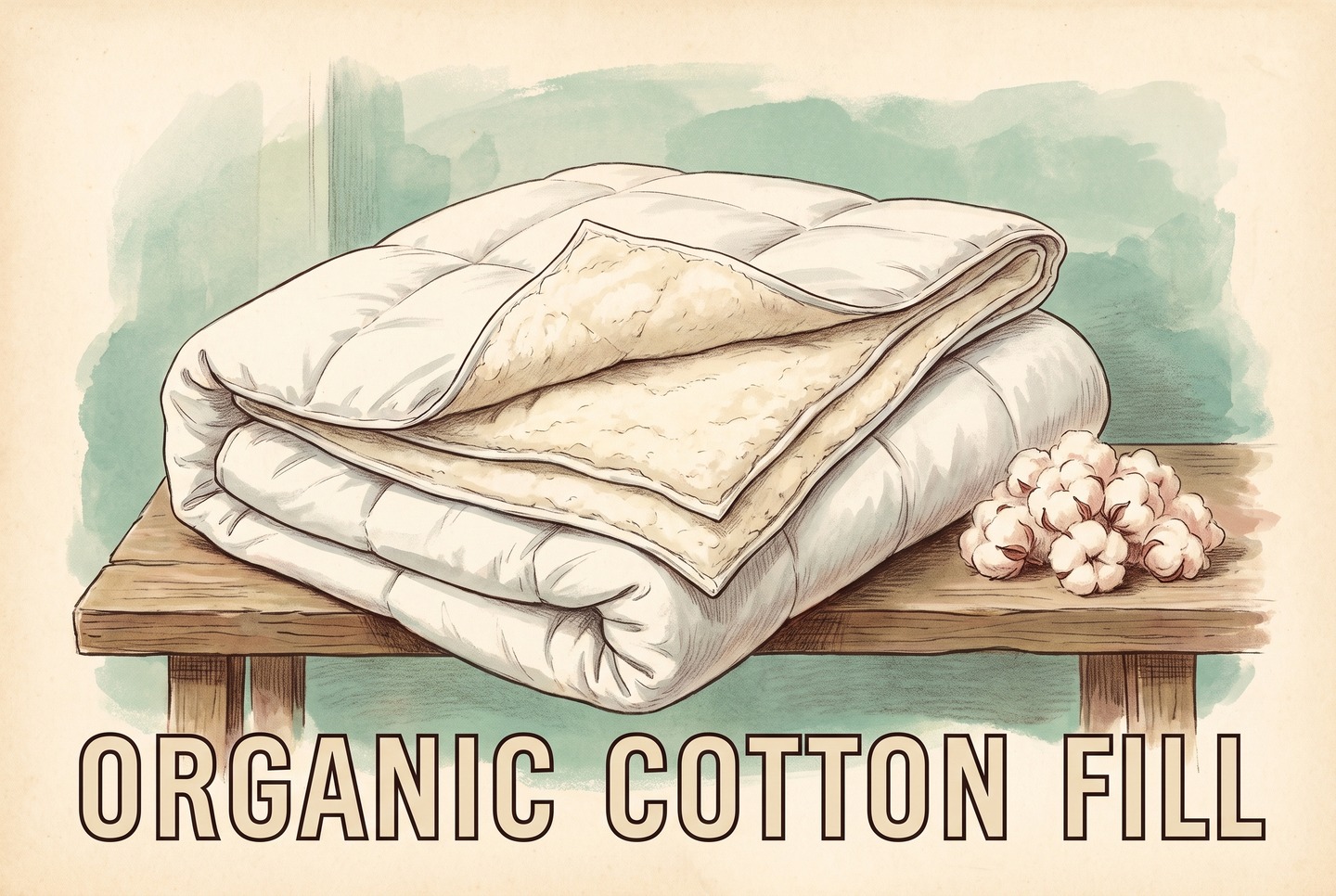
Most listings for an organic cotton comforter describe the fabric you touch. The fill underneath can be down, wool, silk, polyester or cotton. These are two separate claims. US label rules treat the shell and the fill apart. This page shows you how to tell which one you're buying.
Short answer: Often only the shell is organic. We read 9 seller pages, and 7 of them put an organic cotton shell over a different fill. Six used animal fibers such as down, wool or alpaca, and 1 used synthetic fill. The other 2 said the fill itself was organic cotton. GOTS, a private standard for organic textiles, has two label grades, and you can see both below. When you shop, read the fill line and the label grade before the product name.
This guide is for: people in the United States choosing a comforter or duvet insert who want the organic claim to cover what's inside, not only the cover fabric.
Key Takeaways
- Read the fill line before the product name. In our count of 9 seller pages, 7 put an organic cotton shell over a fill that was not cotton. Only 2 stated organic cotton fill. The product name alone rarely showed which kind it was.
- Two GOTS thresholds set the organic label. A GOTS "organic" product needs at least 95% certified organic fiber. "Made with organic" needs at least 70%. The certification section below gives the source.
- Cotton fill is heavy for its size. One listing gives 240 GSM of organic cotton fill. By our arithmetic, that comes to about 2.8 lb (44 oz) across a 90 by 90 inch insert, while a down insert of that size holds 24 oz of fill.
Cotton comforters at a glance
Cotton comforter details reported by 5 makers about their own quilts, checked on October 7, 2026.
| Cotton comforter | Cotton inside | Certificate no. | Fill weight | Trial | Warranty or lifespan | Total |
|---|---|---|---|---|---|---|
| Coyuchi Diamond Stitched Organic Cotton Comforter | Organic cotton batting | Not reported | 360 gsm | 30-day refund; silent on use | Not reported | 2 / 5 |
| Delara Organic Cotton Air Duvet Insert | Organic cotton fill and shell | Points to the GOTS listing, no number printed | Not reported | 7-day home trial | Not reported | 2 / 5 |
| Organic Favorite Organic Cotton Comforter | Synthetic down fill, cotton shell | GOTS and OEKO-TEX named, no number | 600 gsm | 100 nights | 10+ years with care, by its own account | 3 / 5 |
| Q Bedding 100% cotton filled winter duvet insert | 100% cotton fill | Not reported | 640-680 gsm | Not reported | Not reported | 2 / 5 |
| Whisper Organics 240 GSM Organic Cotton Filled Comforter | Organic cotton fill | Not reported | 240 gsm | 1 year, refund if unhappy | 1-year warranty | 4 / 5 |
Editor's picks
The bar for a pick: from 5 cotton comforters read, the maker or makers reporting the most of the 5 details listed below, with 3 as the least that counts. Ties sit alphabetically and are not ranked.
- Cotton named as the fill.
- A certificate number reported.
- Fill weight in gsm or ounces.
- A trial that allows use.
- States a lifespan or warranty for the duvet in years.
- Whisper Organics 240 GSM Organic Cotton Filled Comforter: 4 of 5, Organic cotton fill; 240 gsm; 1 year, refund if unhappy; 1-year warranty.
Clearing the bar is about candour, not loft. Every cotton comforter here was bought and handled, but none was weighed or measured, so warmth is not part of the test.
On This Page
What does an organic cotton comforter label mean in the US?
It usually names the fabric of the shell. US rules let a seller call a fiber organic without saying the whole comforter is certified.
The product name is marketing copy. The legal detail sits in the fiber content statement. The FTC says that statement must list each fiber making up 5% or more of the product's weight, by generic name and percentage (FTC). "100% Cotton" should not appear on a product unless it contains only cotton, apart from trim.
USDA sets a second set of rules for organic claims. USDA says that when every instance of a fiber in the finished product is certified organic, the label may call that fiber organic and state its percentage (USDA AMS). That tells you about one fiber. USDA also says a textile label may not imply the finished product is USDA organic unless the whole product is certified to those rules.
Here is what that means in practice. A comforter with an organic cotton shell and a polyester fill can truthfully be sold as having an organic cotton shell. You can only learn what's inside from the fill line, the fiber content label, or by asking the seller.
The Organic Trade Association adds one more piece. USDA rules cover growing raw cotton and wool, but they set no processing standard for finished textile products such as t-shirts or mattresses (OTA). That gap is why, for finished bedding, you will mostly rely on a private standard covered further down.
Is the fill inside an organic cotton comforter organic too?
Only sometimes. Many sellers pair an organic cotton shell with down, wool, silk or polyester, so the fill line tells you more than the name.
Often it is not. The seller pages we read showed three common builds, and every one of them had an organic cotton shell.
Down under an organic shell is the most common build. The Company Store sells its organic cotton comforters in light, medium and extra-warm versions, with queen down fill of 29 oz, 35 oz and 42 oz (The Company Store). Puredown pairs a 100% organic cotton shell with a fill of down and feathers (Puredown).
Synthetic fill shows up too. One king comforter pairs an organic cotton sateen shell with synthetic down at 600 GSM, a metric fill weight that the table further down converts to ounces (Organic Favorite).
Cotton fill exists, and some makers say so outright. Delara lists organic cotton fill inside an organic cotton shell (Delara). Whisper Organics lists 240 GSM of organic cotton fill inside a 300 thread count organic cotton shell (Whisper Organics). Before you buy, ask whether any organic claim covers the finished comforter.
Watch for hidden layers as well. Avocado's down insert has an organic cotton shell with a down-proof polyester lining (Avocado). Under FTC rules, a lining appears in the fiber content only when it is there for warmth (FTC, Threading Your Way).
How many seller pages say the fill is organic cotton?
Two of the 9 we read. The other seven paired an organic cotton shell with a different fill, and six of those fills came from animals.
We read 9 seller product pages for organic cotton comforters and duvet inserts between September 25 and 26, 2026. We sorted each page into three buckets by what it says about the fill. We did not handle any of these products. This is a count of what the pages claim. Where two shops listed the same comforter, we counted it once.
| Seller page | What the page states about the fill | Our bucket |
|---|---|---|
| Delara | Organic cotton fill and shell | Organic cotton fill stated |
| Whisper Organics | 240 GSM organic cotton fill | Organic cotton fill stated |
| The Company Store | Down | Organic shell, animal fiber fill |
| Puredown all-season | Down and feathers | Organic shell, animal fiber fill |
| Naturepedic down | 750 fill-power duck down | Organic shell, animal fiber fill |
| Naturepedic wool | Organic wool | Organic shell, animal fiber fill |
| Avocado down | 650 fill-power down | Organic shell, animal fiber fill |
| Avocado alpaca | Alpaca fiber | Organic shell, animal fiber fill |
| Organic Favorite | Synthetic down | Organic shell, synthetic fill |
The final split was 2 pages stating organic cotton fill, 6 pairing an organic shell with an animal fiber fill, and 1 pairing it with a synthetic fill. The buckets are our judgement. Pages change. The pages came from searches for organic cotton comforters and duvet inserts, not a random sample, so the split does not measure market share.
Which certification covers the whole comforter, not just the shell?
A GOTS claim applies to the finished product, fill included. OEKO-TEX STANDARD 100 tests for harmful substances but does not certify organic fiber.
GOTS follows a comforter from fiber to finished product. It is backed by independent certification of the entire textile supply chain, from harvesting the raw fiber up to labelling (Specialty Fabrics Review). That means the fill is part of what gets checked, not only the cover fabric. So a comforter carrying the GOTS label should have its fill covered too. USDA confirms that textiles meeting GOTS may be sold as organic in the United States (USDA AMS).
| Label or claim | What it tells you about the fill | Source |
|---|---|---|
| GOTS "organic" | At least 95% of the product's fiber is certified organic | Specialty Fabrics Review |
| GOTS "made with organic" | At least 70% of the fiber is certified organic | Specialty Fabrics Review |
| USDA fiber claim | The named fiber is organic, with its percentage. Says nothing about the rest | USDA AMS |
| OEKO-TEX STANDARD 100 | Every thread and component is tested against over 1,000 harmful substances | OEKO-TEX |
OEKO-TEX is a different kind of test. Hohenstein, an OEKO-TEX institute, describes STANDARD 100 as a product safety standard. Its certification runs for 12 months at a time (Hohenstein). To get the fill covered, ask the seller whether the finished comforter itself carries the GOTS label. A certified cover fabric alone does not count. Ask before you buy.
How heavy is an organic cotton comforter with cotton fill?
Heavier than down for the same size. A 240 GSM cotton fill works out to about 2.8 lb of fiber across a 90 by 90 inch insert.
The figures sellers publish show cotton fill weighing more per square yard than down. Sellers use different units. The table converts each figure to ounces per square yard. It then spreads that over a 90 by 90 inch insert, which is the Full/Queen size of the down insert in our list.
| Fill | Fill per square yard | Over a 90 by 90 inch insert (6.25 sq yd) |
|---|---|---|
| Organic cotton (Whisper Organics) | 7.1 oz (240 g/m²) | 44 oz (2.8 lb) |
| Organic wool (Naturepedic) | 14.7 oz (500 g/m²) | 92 oz (5.7 lb) |
| Synthetic down (Organic Favorite) | 17.7 oz (600 g/m²) | 111 oz (6.9 lb) |
| Down, all-season (Avocado) | 3.8 oz (24 oz total) | 24 oz (1.5 lb) |
| Down, lightweight (Avocado) | 3.2 oz (20 oz total) | 20 oz (1.25 lb) |
The stated figures come from the seller pages for Whisper Organics, Naturepedic, Organic Favorite and the Avocado down insert.
The figures in brackets come from those pages. The per-yard conversions and the insert totals are our arithmetic, not a figure any maker publishes. They count the fill only, not the shell. A given insert may be a different size. Avocado lists its alpaca Full/Queen at 96 by 92 inches and 7.6 lb in total (Avocado).
Weight won't tell you warmth. Heavier fill does mean more to lift and wash. For whether a cotton comforter is cotton all the way through, see Is a 100% cotton comforter cotton inside, too?
Is an organic cotton comforter warm enough for winter?
It depends on the fill, not the shell. Sellers pitch cotton fill at warm sleepers and suggest wool, down or a second layer for cold rooms.
The fill sets the warmth, so the organic shell says little here. If you sleep hot, sellers of cotton-filled inserts are aiming at you. Delara calls its cotton insert ideal for hot sleepers and humid climates. For colder nights, it suggests adding a blanket or choosing a wool insert (Delara).
Down sellers grade warmth by fill weight. The Company Store's queen organic cotton down comforter goes from 29 oz of fill in the light version to 42 oz in the extra-warm one (The Company Store). One person on that page asked what light, medium and extra mean. That's a fair question. You are reading the seller's own labels.
Wool is the other common fill under an organic shell. Naturepedic lists about 500 GSM of organic wool inside a cotton percale shell (Naturepedic).
Match the fill to your bedroom. If you sleep hot, cotton fill fits what sellers claim for it. If your room runs cold, you'll likely end up with down or wool inside an organic cotton shell. That is a sound choice, as long as you know the fill is not organic cotton.
Can you wash an organic cotton comforter at home?
Some, yes. Several cotton and down pages say machine wash cold, while the wool and alpaca inserts we read say spot clean only.
How you clean it depends on the fill. The cotton and down listings we read allowed machine washing, and the wool and alpaca listings did not. Here is what each page tells you.
- Whisper Organics' cotton-filled comforter: machine washable, with a 1-year warranty and free returns (Whisper Organics).
- Puredown's down comforter: machine wash cold on a gentle cycle, then tumble dry low or air fluff (Puredown).
- Naturepedic's wool insert: spot clean only, with a duvet cover recommended (Naturepedic).
- Avocado's alpaca insert: spot clean only, with no machine washing or dry cleaning (Avocado).
Size matters too. A king with cotton fill holds a lot of fiber, and one seller argues it is too heavy for a home machine (Organic Favorite). You are reading the seller's claim there. If you plan to wash at home, compare the comforter's size with what your machine can hold before you order.
If you put a washable cover over a spot-clean insert, cleaning stays simple.
Should you buy an organic cotton comforter or a duvet insert?
They are often the same object. A duvet insert goes inside a cover you wash; a comforter is often used bare, so the shell fabric matters more.

Many sellers sell one product under both names. Naturepedic calls its wool piece a duvet insert comforter (Naturepedic). The real difference is how you use it.
A duvet insert lives inside a cover, so your cover takes the wear and the washing. Corner loops keep it from sliding around inside your cover. Whisper Organics sews on corner tabs to secure its comforter inside a cover (Whisper Organics), and Organic Favorite lists 8 loops for cover ties (Organic Favorite). A comforter used bare puts the shell against your skin, so the shell fabric and its care instructions count for more.
Check dimensions before you pair the two. Avocado's organic cotton duvet cover in Full/Queen is 96 by 92 inches (Avocado). That matches its alpaca insert. Its down insert, also sold as Full/Queen, is 90 by 90 inches. If you mix brands, compare the inches, not the size name.
If you want more on how inserts are built, see What is inside a cotton duvet insert, and how do you pick one? and What a cotton duvet is.
Common questions
Is organic cotton safer to sleep under than regular cotton?
Organic rules cover how the fiber is grown, and you need a separate label for tests on the finished item. OEKO-TEX STANDARD 100, for example, checks every thread and button against over 1,000 substances (OEKO-TEX). You may want both.
How much of the world's cotton is organic?
Very little. Textile Exchange estimated that about 1.4% of all cotton grown in 2020/21 was organic (Textile Dialogue, citing Textile Exchange). That's a small supply of fiber for a product you might fill with several pounds of it.
Does "made with organic" mean the fill is organic?
Not necessarily. Under GOTS, that grade means at least 70% of the fiber is certified organic (Specialty Fabrics Review). The rest can be other fiber, so you should ask which part it is.
Can a comforter carry a GOTS label if only the cover is organic?
No. GOTS relies on independent certification of the entire supply chain up to labelling (Specialty Fabrics Review), so a certified cover fabric is only one part. You need the finished product itself to carry the label. Ask the seller to confirm it.
Why are some organic cotton comforters left unbleached?
Some makers skip dyeing and bleaching the cotton. Whisper Organics describes its cotton-filled comforter as undyed and unbleached (Whisper Organics). If you want a bright white comforter, check whether the listing mentions bleaching.
Does "100% cotton" on the label count the thread and trim?
No. The FTC leaves trim, small ornaments and the stitching threads out of fiber content, and it counts linings only when they add warmth (FTC). You can still find non-cotton trim under a "100% Cotton" label.
Sources
Reading list for this cotton duvet piece, each title paired with the section where it does its work.
- Coyuchi (coyuchi.com), at work in “Cotton comforters at a glance”.
- 30-day refund; silent on use (coyuchi.com), at work in “Cotton comforters at a glance”.
- Delara (delarahome.com), at work in “Cotton comforters at a glance”; “Is the fill inside an organic cotton comforter organic too?”; “How many seller pages say the fill is organic cotton?”; “Is an organic cotton comforter warm enough for winter?”.
- Points to the GOTS listing, no number printed (delarahome.com), at work in “Cotton comforters at a glance”.
- Organic Favorite (organicfavorite.com), at work in “Cotton comforters at a glance”; “Is the fill inside an organic cotton comforter organic too?”; “How many seller pages say the fill is organic cotton?”; “How heavy is an organic cotton comforter with cotton fill?”; “Can you wash an organic cotton comforter at home?”; “Should you buy an organic cotton comforter or a duvet insert?”.
- Q Bedding (qbedding.com), at work in “Cotton comforters at a glance”.
- Whisper Organics (whisper-organics.com), at work in “Cotton comforters at a glance”; “Editor's picks”; “Is the fill inside an organic cotton comforter organic too?”; “How many seller pages say the fill is organic cotton?”; “How heavy is an organic cotton comforter with cotton fill?”; “Can you wash an organic cotton comforter at home?”; “Should you buy an organic cotton comforter or a duvet insert?”; “Common questions”.
- FTC (ftc.gov), at work in “What does an organic cotton comforter label mean in the US?”.
- USDA AMS (ams.usda.gov), at work in “What does an organic cotton comforter label mean in the US?”; “Which certification covers the whole comforter, not just the shell?”.
- OTA (ota.com), at work in “What does an organic cotton comforter label mean in the US?”.
- The Company Store (thecompanystore.com), at work in “Is the fill inside an organic cotton comforter organic too?”; “How many seller pages say the fill is organic cotton?”; “Is an organic cotton comforter warm enough for winter?”.
- Puredown (puredown.com), at work in “Is the fill inside an organic cotton comforter organic too?”; “How many seller pages say the fill is organic cotton?”; “Can you wash an organic cotton comforter at home?”.
- Avocado (avocadogreenmattress.com), at work in “Is the fill inside an organic cotton comforter organic too?”; “How many seller pages say the fill is organic cotton?”; “How heavy is an organic cotton comforter with cotton fill?”.
- FTC, Threading Your Way (ftc.gov), at work in “Is the fill inside an organic cotton comforter organic too?”; “Common questions”.
- Naturepedic down (naturepedic.com), at work in “How many seller pages say the fill is organic cotton?”.
- Naturepedic wool (naturepedic.com), at work in “How many seller pages say the fill is organic cotton?”; “How heavy is an organic cotton comforter with cotton fill?”; “Is an organic cotton comforter warm enough for winter?”; “Can you wash an organic cotton comforter at home?”; “Should you buy an organic cotton comforter or a duvet insert?”.
- Avocado alpaca (avocadogreenmattress.com), at work in “How many seller pages say the fill is organic cotton?”; “How heavy is an organic cotton comforter with cotton fill?”; “Can you wash an organic cotton comforter at home?”.
- Specialty Fabrics Review (specialtyfabricsreview.com), at work in “Which certification covers the whole comforter, not just the shell?”; “Common questions”.
- OEKO-TEX (oeko-tex.com), at work in “Which certification covers the whole comforter, not just the shell?”; “Common questions”.
- Hohenstein (hohenstein.us), at work in “Which certification covers the whole comforter, not just the shell?”.
- Avocado (avocadogreenmattress.com), at work in “Should you buy an organic cotton comforter or a duvet insert?”.
- Textile Dialogue, citing Textile Exchange (textilbuendnis.com), at work in “Common questions”.