What size cotton comforter do you need for a queen or king bed?
Updated .
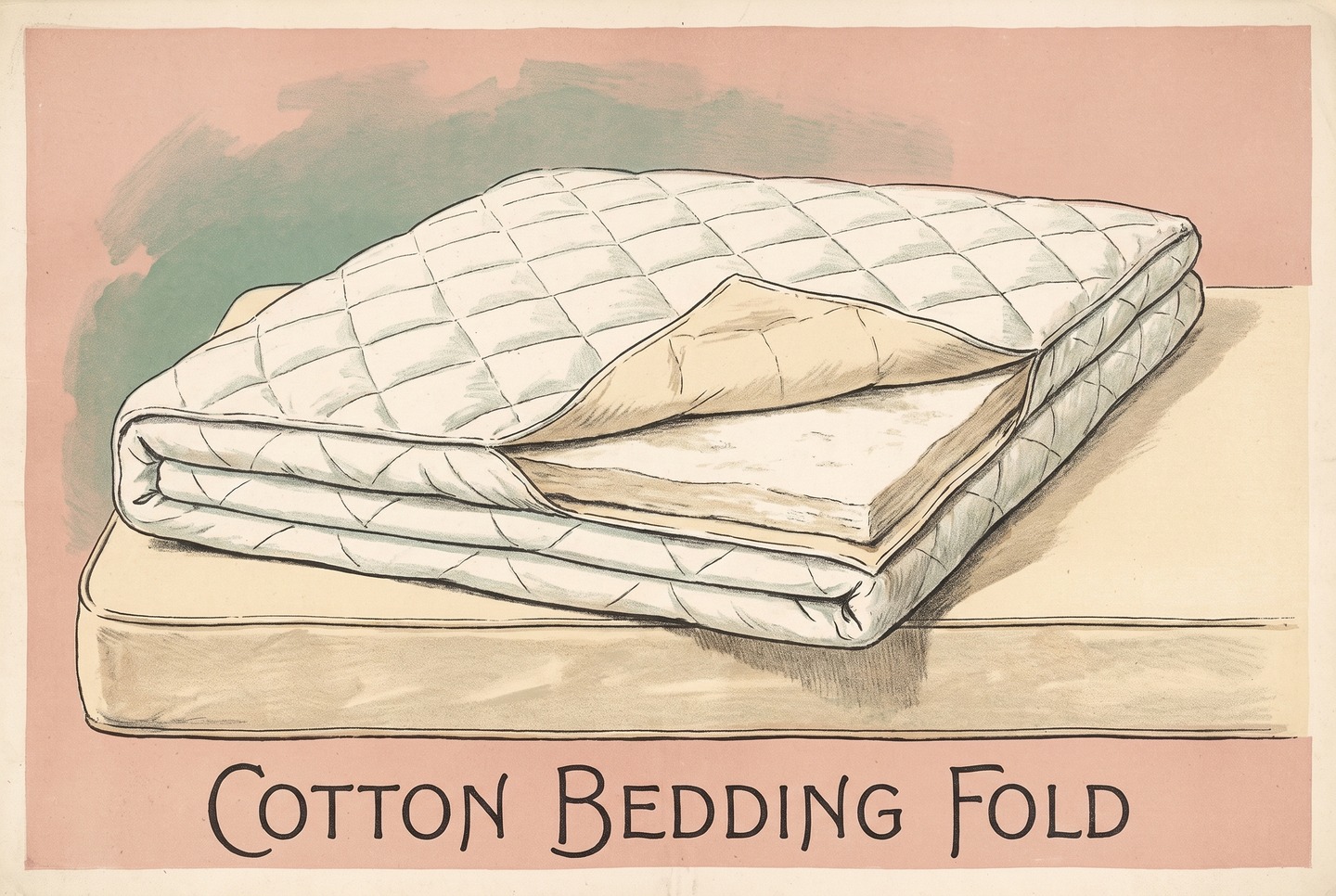
A queen mattress is 60 by 80 inches and a king is 76 by 80 (Sleep Advisor), but the cotton comforters sold for those beds don't follow one size.
The label raises a second question too. "100% cotton" may describe only the fabric you touch, not the layer that keeps you warm.
Short answer: Every queen size on the pages we read was 88 to 92 inches wide, and most kings were 104 to 108. To check yours, double your mattress height and add the mattress width. That gives the width that reaches the bottom of both sides. Then find the fill line. A cotton shell over polyester or down can still be sold as a cotton comforter, so look for a separate line that names the filling.
This guide is for: people buying a queen or king comforter who want cotton against the skin and want to know if it is cotton inside as well.
Key Takeaways
Three numbers settle most of this purchase: the width your bed needs, what the fill is, and how much the cotton weighs and shrinks.
- Width decides fit. On a 12-inch-high mattress you need about 84 inches of width for a queen and 100 for a king. That uses the Sleep Foundation method: double the height and add the mattress width.
- Cotton outside does not mean cotton inside. Of 7 seller pages we read on September 26, 2026, 3 said the fill was cotton, 3 said it was something else under a cotton shell, and 1 said both.
- Cotton fill is weighty and shrinks. The one cotton-filled queen that gave a total weight listed 6.3 pounds, and Coyuchi's 360 gsm batting holds 1.5 times as much fill per square foot as a 240 gsm fill. One batting seller expects 3% to 5% shrinkage, which is about 2.8 to 4.6 inches off a 92-inch comforter.
On This Page
Eight questions, in roughly the order people ask them, running from the size of the comforter to what the fill is and how you wash it.
What size is a queen cotton comforter?
Queen cotton comforters on the pages we read were sold at 88 to 92 inches wide, for a mattress that is 60 inches wide and 80 inches long.
Your mattress size is fixed. The comforter's is not. One sizing guide puts a typical queen comforter at 86 to 88 inches wide and 96 to 100 inches long (Sleep Junkie). The cotton pages we read ran wider than that, and you will often find them shorter.
Puredown lists its Full/Queen at 88 by 90 inches. The Whisper Organics comforter on Natural Linens is 90 by 92. Crane & Canopy gives 90 by 94, and Coyuchi at Fine Linens gives 92 by 88. L.L.Bean lists 88 by 96.
Queen widths on these pages ran from 88 to 92 inches, a 4-inch spread under one size name. Lengths varied more, from 88 to 96 inches. If the foot of the bed matters to you, read the second figure as closely as the first.
Watch for the words Full/Queen. Most of these pages sell you one size for two beds. A full mattress is 54 inches by 75 inches (Sleep Advisor), which is 6 inches narrower than a queen. So one size has to hang long on a full or come up short on a tall queen. You only find out which by comparing the figures with your own mattress height. The sizing section below shows how.
What size is a king cotton comforter?
King cotton comforters on the pages we read ran 104 to 108 inches wide for a 76-inch mattress, giving about the same side drop as a queen.
A standard king mattress is 76 inches wide and 80 inches long (Sleep Advisor), so you need 16 more inches of width than on a queen. The king listings we read ran from 104 to 108 inches wide. Whisper Organics lists 104 by 92 inches, Puredown 104 by 90, and L.L.Bean 107 by 96. Crane & Canopy sells one King/Cal King at 108 by 94.
If you do the subtraction, a pattern shows. Take 76 from 104 and 28 inches are left, or 14 on each side. From 108 you get 16 per side. A king comforter hangs about as far down each side as a queen does on its own bed, because queen widths of 88 to 92 leave the same 14 to 16 inches.
On several pages you will find a single King/Cal King size. A California king bed measures 72 inches by 84 inches (Sleep Junkie). It is narrower. So the sides gain a little. It is also 4 inches longer, and you lose that at the foot.
Does 100% cotton mean the fill is cotton too?
Not always. US labeling rules want warmth fill named in its own line, so a 100% cotton headline can sit over a polyester or down fill.
The rule comes from the Federal Trade Commission. Its labeling guide says fillings "incorporated for warmth" must have their fiber disclosed separately from the outer fabric (FTC). Fillings used only for structure are exempt, but a comforter's fill is there to keep you warm. The federal rules even print "Filling: 100% Cotton" as a model label line (16 CFR Part 303).
That rule covers the sewn-in label you find on the comforter. A product page headline is looser, and that's where "100% cotton" does its work. One queen set on Wayfair is described as 100% cotton, and only further down does the page mention a polyester fill of 8 ounces. L.L.Bean states it more plainly. Its page describes a brushed cotton shell over a lyocell fiberfill.
So read the page the way you would read the label. Search it for fill, filling, batting and insulation. If the only material line says 100% cotton and no line names the inside, you haven't been told what keeps you warm. Ask the seller or move on. Our guide Is a 100% cotton comforter cotton inside, too? goes further into label wording and what each phrase commits a seller to.
How many cotton comforters are cotton inside?
We read 7 seller pages on September 26, 2026. Three stated cotton fill, three stated another fill, and one page said both things at once.
We read 7 product pages on September 26, 2026, each selling a queen or king comforter with a cotton outer fabric. We found them by searching for cotton and cotton-filled comforters, so the set leans toward cotton fill. Treat the split as a reading of these pages, not a share of the market.
- Cotton inside, stated plainly: 3 pages
- A different fill under a cotton shell, stated plainly: 3 pages
- The page contradicts itself: 1 page
The odd one out shows why you should read the whole page. When we read it for this count, the Organic Favorite summary called the comforter 100% organic cotton "inside and out," yet its own spec list gave the fill as synthetic down. By October 7, 2026, that summary line was gone. Our picked comforters were bought and handled, but none was weighed, so every entry is what the page said that day.
| Page | Shell stated | Fill stated | Queen, inches | King, inches | Bucket |
|---|---|---|---|---|---|
| Crane & Canopy | cotton | cotton | 90 × 94 | 108 × 94 | Cotton inside |
| Whisper Organics | organic cotton | organic cotton, 240 gsm | 90 × 92 | 104 × 92 | Cotton inside |
| Coyuchi | organic cotton | organic cotton, 360 gsm | 92 × 88 (Fine Linens) | 108 × 92 | Cotton inside |
| L.L.Bean | brushed cotton | lyocell fiberfill | 88 × 96 | 107 × 96 | Other fill |
| Puredown | organic cotton | down and feather | 88 × 90 | 104 × 90 | Other fill |
| The Company Store | organic cotton, 230 thread count | down; 29 oz in a light queen | not shown | not shown | Other fill |
| Organic Favorite | organic cotton sateen | synthetic down (specs); cotton (summary) | not sold yet | 90 × 104 | Contradicts itself |
How do you work out the size your bed needs?
Double your mattress height and add the width. That gives the comforter width that reaches the bottom of both sides of the mattress.
The Sleep Foundation gives a plain method: "multiply the measured mattress height by two and add it to the measured width." Its own example is a 60-inch-wide mattress that is 15 inches high, which needs a comforter 90 inches wide to cover both sides.
Measure your mattress height at the side with a tape. Include any topper. Then read across.
| Mattress height | Queen width needed | King width needed | Length with one drop at the foot |
|---|---|---|---|
| 10 in | 80 in | 96 in | 90 in |
| 12 in | 84 in | 100 in | 92 in |
| 14 in | 88 in | 104 in | 94 in |
| 16 in | 92 in | 108 in | 96 in |
The length column is our own arithmetic, not the Sleep Foundation's. It adds one drop at the foot to the 80-inch mattress length and leaves nothing for the pillows. If you tuck the comforter under your pillows, that uses up some of the length.
Queen widths of 88 to 92 inches reach the bottom of a mattress up to 14 to 16 inches high. King widths of 104 to 108 do the same on a king. If you want the sides to hang lower, the Sleep Foundation suggests adding a few inches. On a tall mattress that usually means buying the next size up. Check the length against the drop you want at the foot as well, because some queen lengths we read were only 88 inches.
How heavy is a cotton-filled comforter?
The one cotton-filled queen that listed a total weight came in at 6.3 pounds, and another's batting carries 1.5 times as much cotton per square foot.
Comforter pages give weight in two ways, and neither tells you how warm it is. Some list the whole comforter in pounds, which is the weight you feel lying under it. Others list the fill in gsm, grams per square meter, a unit you rarely see anywhere else in the US. To turn gsm into ounces per square foot, multiply by 0.0033.
| Page | What the page states | Fill in US units |
|---|---|---|
| Whisper Organics via Natural Linens | 240 gsm cotton fill; 6.3 lb at 90 × 92 in | 0.79 oz per sq ft |
| Coyuchi | 360 gsm cotton batting; 92 × 88 in per Fine Linens | 1.18 oz per sq ft |
| Puredown, down, for contrast | 52 oz fill at 88 × 90 in | 0.95 oz per sq ft |
By our arithmetic, Coyuchi's 360 gsm batting puts 1.5 times as much cotton in each square foot as the Whisper Organics 240 gsm fill. The Whisper Organics queen weighs about 1.75 ounces per square foot in all, shell included, and you feel the difference lying under it.
One cotton-filled comforter on Natural Linens is described as "recommended for someone who sleeps cold, or prefers a more weighted comforter."
A heavier comforter isn't necessarily warmer. This publication measured neither weight nor warmth. The table tells you how heavy each one is. If you want a comforter you can lift with one hand when you make the bed, go by the ounces per square foot, not the size name.
Can you wash a cotton comforter at home?
Usually, if the page says so and your washer is big enough. Cotton batting shrinks a little on the first wash, so use cold water and low heat.
Care instructions on these pages ranged from a gentle home wash to a large commercial machine. Crane & Canopy says to machine wash cold on delicate, or dry clean. A reseller of the Coyuchi comforter recommends the gentle or delicate cycle in cold water (Organic Living AZ). L.L.Bean asks for a large commercial machine.
Weight explains some of this. A 6.3-pound queen of cotton soaks up a lot of water. Check your washer's capacity first. A large front-loader at a laundromat may be the safer choice.
Cotton batting also shrinks. One batting seller says washing usually shrinks cotton batting by about 3 to 5% (Fanda Fabrics). One seller advises line drying or low heat to avoid shrinkage (Natural Linens).
On a 92-inch queen, that is roughly 2.8 to 4.6 inches, and on a 108-inch king it is 3.2 to 5.4. If your comforter only just covers the sides when new, it may come up short after the first wash.
Between two sizes? Shrinkage is a reason to take the larger one. You lose nothing on the first night, and you keep full coverage after a year of washing.
Is an organic cotton comforter organic all the way through?
Only if the certificate covers the finished comforter. GOTS allows its organic grade at 95% organic fiber and a made-with grade from 70%.
You meet a similar catch with organic claims. GOTS, the Global Organic Textile Standard, sets label grades for finished products. Its "made with organic" grade requires at least 70% of the product's fiber to be certified organic (The Roundup). The Organic grade requires at least 95% organic fiber (SleepRanked).
The harder question is which part the certificate covers. Puredown's page puts its GOTS claim on the shell alone, and the fill is down and feathers. That is an organic shell, not an organic comforter. The Whisper Organics listing on Natural Linens places its GOTS claim on the whole comforter, and its fill is organic cotton. The Coyuchi reseller lists GOTS and, separately, Fair Trade for the shell fabric, which reads as two claims about two parts.
A reviewer of mattresses makes the same point: an organic cotton cover on its own does not make the finished mattress certified. You can apply the same logic to a comforter. Ask the seller for the certificate, then check that it names the finished comforter. Our guide Is an organic cotton comforter organic on the inside? explains what to ask for.
Common questions
Six short answers to the questions that come up after sizing, from putting a king on a queen to reading gsm on a seller's listing.
Can you put a king comforter on a queen bed?
Yes, if you want long sides. A king that is 104 to 108 inches wide leaves 22 to 24 inches hanging on each side of a 60-inch queen, which on a low frame can reach the floor. With cotton fill, the extra width also means extra weight on you.
Is a full/queen comforter big enough for a queen bed?
For most mattresses, yes. The Full/Queen sizes we read were 88 to 92 inches wide. By the Sleep Foundation method, that covers a queen mattress up to 14 to 16 inches high. Measure first if yours is taller or has a topper.
Does a California king need its own comforter?
Not always. A California king is 72 by 84 inches, so a King/Cal King size is wide enough. The catch is length. You give up about 4 inches at the foot compared with a standard king.
Are cotton-filled comforters warm?
These pages can't tell you, and we measured none of them. Sellers give weights, not warmth ratings. Compare fill only between two cotton comforters, where more gsm means more cotton around you. Our guide to fill weight in ounces and GSM shows the arithmetic.
What does gsm mean on a comforter listing?
It stands for grams per square meter: how much the fill weighs across one square meter. Multiply by 0.0033 to get ounces per square foot. A 240 gsm fill works out to about 0.79 ounces per square foot, and 360 gsm to about 1.18.
Can you use a cotton comforter inside a duvet cover?
Many are made for it. Coyuchi recommends its comforter "as a stand-alone comforter or a lightweight duvet insert," and Whisper Organics adds corner tabs (Whisper Organics). Match the cover to the comforter's measurements, not its size name. Our guide What is inside a cotton duvet insert, and how do you pick one? covers the fit.
Sources
Reading list for this cotton duvet piece, each title paired with the section where it does its work.
- Sleep Advisor (sleepadvisor.org), at work in “What size is a queen cotton comforter?”; “What size is a king cotton comforter?”.
- Sleep Junkie (sleepjunkie.com), at work in “What size is a queen cotton comforter?”; “What size is a king cotton comforter?”.
- Puredown (puredown.com), at work in “What size is a queen cotton comforter?”; “What size is a king cotton comforter?”; “How many cotton comforters are cotton inside?”; “How heavy is a cotton-filled comforter?”.
- Natural Linens (naturallinens.com), at work in “What size is a queen cotton comforter?”; “What size is a king cotton comforter?”; “How many cotton comforters are cotton inside?”; “How heavy is a cotton-filled comforter?”.
- Crane & Canopy (craneandcanopy.com), at work in “What size is a queen cotton comforter?”; “What size is a king cotton comforter?”; “How many cotton comforters are cotton inside?”.
- Coyuchi at Fine Linens (finelinens.com), at work in “What size is a queen cotton comforter?”; “How many cotton comforters are cotton inside?”; “How heavy is a cotton-filled comforter?”.
- L.L.Bean (global.llbean.com), at work in “What size is a queen cotton comforter?”; “What size is a king cotton comforter?”; “Does 100% cotton mean the fill is cotton too?”; “How many cotton comforters are cotton inside?”; “Can you wash a cotton comforter at home?”.
- FTC (ftc.gov), at work in “Does 100% cotton mean the fill is cotton too?”.
- 16 CFR Part 303 (ecfr.gov), at work in “Does 100% cotton mean the fill is cotton too?”.
- Wayfair (wayfair.com), at work in “Does 100% cotton mean the fill is cotton too?”.
- Organic Favorite (organicfavorite.com), at work in “How many cotton comforters are cotton inside?”.
- Coyuchi (coyuchi.com), at work in “How many cotton comforters are cotton inside?”; “How heavy is a cotton-filled comforter?”.
- The Company Store (thecompanystore.com), at work in “How many cotton comforters are cotton inside?”.
- Sleep Foundation (sleepfoundation.org), at work in “How do you work out the size your bed needs?”.
- Natural Linens (naturallinens.com), at work in “How heavy is a cotton-filled comforter?”; “Can you wash a cotton comforter at home?”.
- Organic Living AZ (organiclivingaz.com), at work in “Can you wash a cotton comforter at home?”.
- Fanda Fabrics (fandafabrics.com), at work in “Can you wash a cotton comforter at home?”.
- The Roundup (theroundup.org), at work in “Is an organic cotton comforter organic all the way through?”.
- SleepRanked (sleepranked.com), at work in “Is an organic cotton comforter organic all the way through?”.
- Whisper Organics (whisper-organics.com), at work in “Common questions”.