What size duvet do you need, and how much overhang will you get once you are in bed?
Updated .
A duvet size is the name of a range. It is not a measurement. A US queen mattress is 60 by 80 inches (Avocado help center).
The six seller pages we read listed queen duvets and covers anywhere from 88 to 98 inches wide. The chart on the bag also assumes a flat, empty mattress. Yours has depth. At least one person sleeps in it.
Short answer: Buy by width, not by name. Take your mattress width, add twice its depth, then add about 9 inches for each person who sleeps under the duvet. For one person on a 10-inch queen that comes to about 89 inches, so a standard 90-inch queen works. For two people on a 12-inch queen it comes to about 102 inches, which puts you in king sizes. The size chart assumes an empty bed, and nobody sleeps in one.
This guide is for: people in the United States choosing a duvet or insert for a twin, full, queen, king or California king bed, and anyone whose duvet looks short once it is on the bed.
Key Takeaways
Three numbers carry most of this guide: the mattress width, the mattress depth, and how many people sleep under the duvet each night.
- Width decides the fit. A queen mattress is 60 inches wide, and the six seller pages we read listed queen duvets from 88 to 98 inches wide. On an empty bed, that leaves 14 to 19 inches hanging on each side.
- Sleepers take width back. By our arithmetic, each person under the duvet takes back about 9 inches of width. Two adults under a 90-inch queen duvet leave about 6 inches per side, not 15.
- Depth sets the target. Most mattresses are 10 to 12 inches thick, and each side needs at least that much overhang to hide the edge. A couple on a 12-inch queen needs a duvet about 102 inches wide, which means a king.
On This Page
Eight questions, in the order a buyer tends to ask them, from the size chart to the tape measure, followed by six shorter answers at the end.
What size duvet fits each US mattress?
A queen mattress is 60 by 80 inches and most queen duvets run 88 to 98 inches wide, so the size name alone tells you less than the width does.
Start with the mattress. Its size is the one fixed number in your bedroom. Avocado's size guide lists six standard US sizes: Twin (38" x 75"), Twin XL (38" x 80"), Full (54" x 75"), Queen (60" x 80"), King (76" x 80"), and California King (72" x 84"). Serta's copy of the ISPA dimension standard lets a finished mattress vary by half an inch either way.
Duvets have no such standard. Each seller picks its own width, and many sell a single "full/queen" size for both beds. Tuft & Needle lists its inserts at 68 inches wide for Twin/Twin XL, 98 for Full/Queen and 116 for King/Cal King. So the same duvet gives a full bed more overhang than a queen.
The table pairs each mattress with duvet widths that sellers list for their own products. The last column is plain subtraction.
| Mattress | Mattress size (inches) | Duvet widths sellers list (inches) | Overhang per side, empty bed |
|---|---|---|---|
| Twin / Twin XL | 38 x 75 / 38 x 80 | 66 to 68 | 14 to 15 |
| Full | 54 x 75 | 88 to 98 (full/queen sizes) | 17 to 22 |
| Queen | 60 x 80 | 88 to 98 | 14 to 19 |
| King | 76 x 80 | 106 to 116 | 15 to 20 |
| California King | 72 x 84 | 104 to 116 | 16 to 22 |
The duvet widths come from each seller's own page: Qbedding, Tuft & Needle, Westex and Beddley.
Go by the width, not the name. Every duvet width above is on a seller's own page, so you can check it before you buy.
How much overhang does a duvet give on each side?
Subtract the mattress width from the duvet width and halve it. That is your overhang per side with nobody in the bed, and it is the best case.
The arithmetic is short. Subtract the mattress width from the duvet width, then halve the result. A 90-inch duvet on a 60-inch queen leaves 15 inches hanging on each side. A 106-inch duvet on a 76-inch king leaves the same 15 inches.
Those 15 inches assume nobody is in the bed. They also assume the duvet lies flat and dead center. It drifts after the first night.
Length works differently, and it is seldom the problem. You do not pull a duvet over your pillows.
A standard pillow is 20" x 26" (Nest Bedding), and it lies with its short side running down the bed.
So on an 80-inch queen, about 60 inches of mattress sits below the pillows. A duvet 90 inches long covers that. It still has about 30 inches to spare at the foot, which is enough for even a deep mattress.
The sides are where you run short. They have to cover the full depth of the mattress, and they are the part your body pulls on. If your duvet looks fine at the foot but shows the mattress along the sides, the width is too small. The next two sections show where those side inches go and how many you need.
What overhang does nobody account for?
Your body lifts the duvet off the mattress. Each sleeper takes back several inches of width, so the overhang you see in a shop shrinks at night.
Charts are drawn for an empty bed. Once you lie down, the duvet rises over your body. Then it comes back down. That climb uses width that would otherwise hang over the edge.
How much width? A peer-reviewed study of US adults used 2011–2012 national survey data to measure abdominal height with people lying on their backs. The median was 21.9 cm, and men measured higher than women.
That median converts to about 8.6 inches. We assume each sleeper takes back about 9 inches of width. That is the median rounded up. The duvet climbs over the body and back down, but it tents between two people rather than hugging each one.
| Queen duvet width | Overhang per side, empty | One sleeper | Two sleepers |
|---|---|---|---|
| 88 inches | 14 inches | 9.5 inches | 5 inches |
| 90 inches | 15 inches | 10.5 inches | 6 inches |
| 98 inches | 19 inches | 14.5 inches | 10 inches |
| 106 inches (king size) | 23 inches | 18.5 inches | 14 inches |
This table is our arithmetic, not a measurement. No maker publishes it. What matters is the gap between the columns. A couple under a 90-inch queen duvet keeps about 6 inches per side, roughly half the side of a standard mattress. Side sleepers and restless partners pull harder than that, and the mattress edge shows on whichever side loses.
How deep is your mattress, and why does it change the size?
Most mattresses are 10 to 12 inches deep, and the duvet has to drop that far on each side before it covers the edge you can see from the door.
Depth is the number most shoppers skip. The Sleep Foundation says the average mattress ranges from 8 to 14 inches tall, and a standard 10 to 12 inches suits most adults. It counts 14 inches and up as extra-thick, and some mattresses reach upward of 20 inches.
To hide the side of your mattress, the overhang on each side has to at least match the depth. A topper adds its own thickness. So a 12-inch mattress with a 2-inch topper needs 14 inches per side before anyone climbs in.
Put depth and sleepers together and you get the width to shop for: mattress width, plus twice the depth, plus about 9 inches per sleeper.
| Mattress depth | Queen, one sleeper | Queen, two sleepers | King, two sleepers |
|---|---|---|---|
| 10 inches | 89 inches | 98 inches | 114 inches |
| 12 inches | 93 inches | 102 inches | 118 inches |
| 14 inches | 97 inches | 106 inches | 122 inches |
These are our judgement figures, built on the 9-inch assumption above. They explain a common complaint. A couple on a 12-inch king needs a duvet close to 118 inches wide.
The widest king insert we found listed was 116 inches (Tuft & Needle).
If your king duvet looks skimpy, the numbers agree with you. Our guide to queen and king comforter sizes covers the same squeeze for comforters.
How much do queen duvets vary from one seller to the next?
Across six seller pages we read, queen duvets ran from 88 to 98 inches wide. That 10-inch spread is 5 inches of overhang on each side.
We read six seller pages on September 26, 2026, each listing the width of its own queen or full/queen duvet insert or cover. The comforters in our picks were bought and handled, but no width here is a measurement of ours. We copied the figure each page prints, sorted the pages into three width buckets, and set out the counting rules on our method page.
| Width bucket | Pages | What each page states |
|---|---|---|
| Under 90 inches | 2 | Qbedding 88 x 96 insert; Sferra Celeste 88 x 92 cover |
| 90 to 94 inches | 2 | Cotton Metrics 90 x 90 insert; Mellanni 90 x 90 cover |
| 95 inches and over | 2 | Casper 95 x 98 cover; Tuft & Needle 98 x 98 insert |
The six pages are Qbedding, Gracious Style's Sferra listing, Cotton Metrics on Amazon, Mellanni, Casper and Tuft & Needle.
The count is small and the split is even. That even split is the finding. Two duvets sold under the same name can differ by 10 inches, which is 5 inches of overhang per side.
Southshore Fine Linens, a linen seller, makes the same point: one brand's queen insert might be 90" x 94", while another is 88" x 92".
Covers add a second variable. You will usually buy the insert and the cover separately. A cover cut for a 98-inch insert hangs loose around an 88-inch one. Write down both numbers before you order. Our page on what goes inside a cotton duvet insert explains how the fill changes the way a given width drapes.
Should you size up to a king duvet on a queen bed?
A king duvet on a queen bed adds about 8 inches on each side. It suits couples and deep mattresses, but it can reach the floor on a low frame.
Often, yes. It helps most when two of you share the bed. Westex lists its king down duvets at 106 x 90 inches.
On a 60-inch queen that gives 23 inches per side on an empty bed. A 90-inch queen gives 15. With two sleepers, the table earlier puts you at about 14 inches per side. That covers a 12-inch mattress.
The floor sets the limit. NapLab puts the average bed at 24 to 25 inches from the floor to the top of the mattress, and calls beds of 11 inches or less low-profile.
A 23-inch drop clears a standard bed but will pool on a low platform. On a low frame, an oversized queen is the smaller step up.
Three checks before you size up:
- Cover: a king insert needs a king cover. Casper advises a cover the same size as the insert or around two inches shorter.
- Length: the Westex king is the same length as a typical queen, so what you gain is width.
- Warmth: more fabric and fill makes a heavier, warmer duvet, so if you run hot, pick a lighter fill in the bigger size.
Is a king on a queen a style choice? Partly. It is also the most direct fix for the width sleepers take back. If the extra warmth worries you, our guide to lightweight cotton comforters explains what makes a bigger cover sleep cooler.
Does a cotton duvet shrink enough to matter?
Cotton shells can shrink a few percent in the first hot wash. On a 90-inch duvet, 5 percent is 4.5 inches, which is over 2 inches per side.
It can, and the loss comes out of the side overhang you counted on. Southshore Fine Linens, citing Online Clothing Study, says cotton can shrink anywhere from two to seven percent, depending on the quality of the fabric and construction. On your bed, that means the duvet edge sits higher up the side of the mattress after the first hot wash.
Apply that range to a 90-inch queen. Two percent costs 1.8 inches of width and seven percent costs 6.3 inches, about 1 to 3 inches per side. With two sleepers, a queen may start with only 6 inches per side, so one hot wash can leave you and your partner with half of that.
Preshrunk or prewashed bedding helps. Its maker has taken some of this shrinkage out before the duvet reaches you. A few habits protect the rest:
- Wash cold and dry on low heat for the first several washes.
- Check whether the seller says the shell is prewashed or preshrunk.
- Measure the duvet flat after its first wash, so you know its real width before you buy a cover.
If you are between two sizes, shrinkage is one more reason to take the larger one. A duvet that starts an inch or two too wide ends up about right. One that starts exactly right ends up short.
How do you measure your bed before you buy?
Measure width and depth with the bedding off. You want a duvet wider than the mattress by twice its depth plus about 9 inches per sleeper.
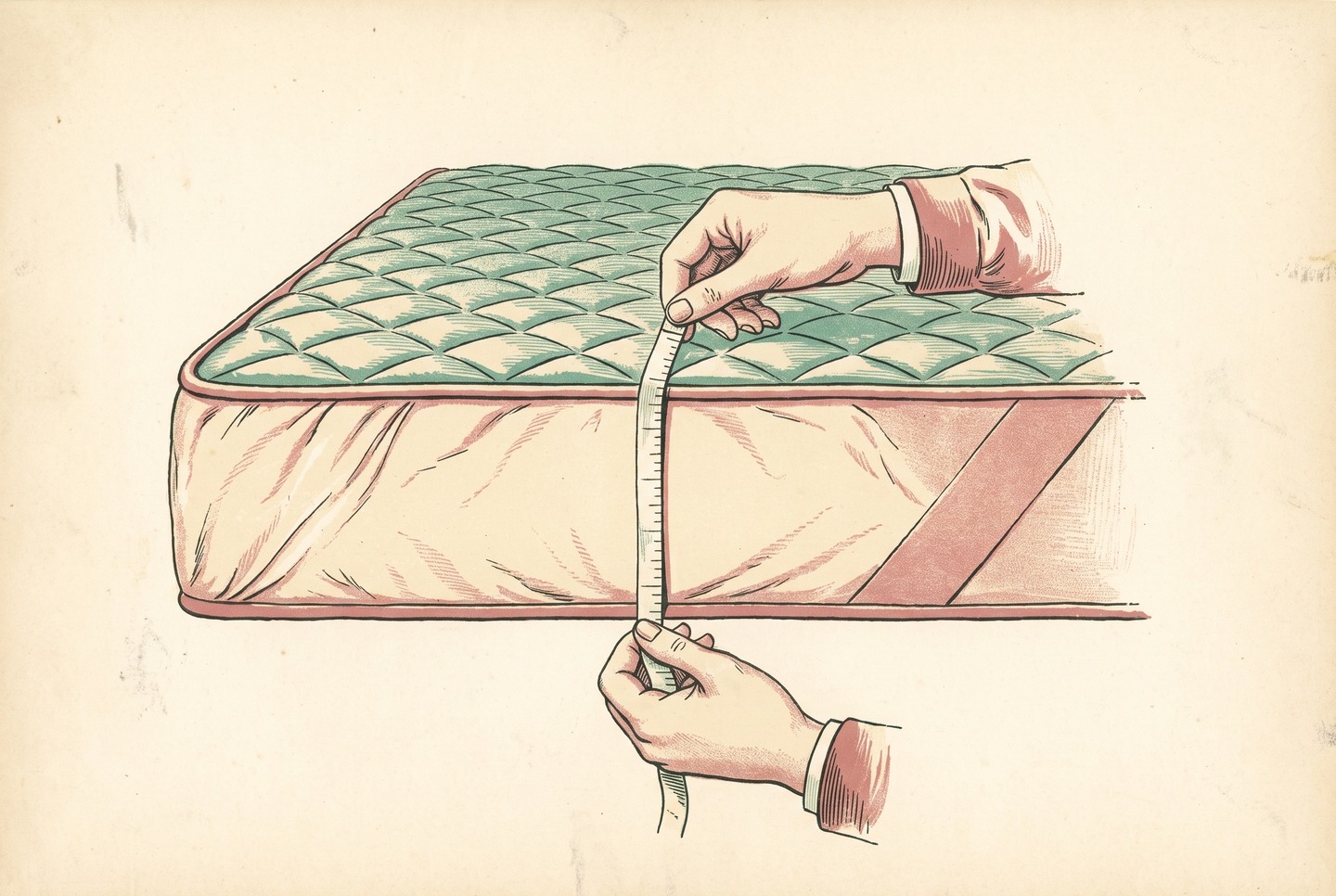
Strip the bed down to the fitted sheet. Find a soft tape measure. Five minutes gets you every number this guide uses.
- Width: measure straight across the top of the mattress, edge to edge. Expect 38, 54, 60, 72 or 76 inches.
- Depth: measure from the bottom of the mattress to the top of its quilted surface, at the middle of one side. Include any topper.
- Floor clearance: measure from the floor to the top of the mattress. Keep your overhang a few inches shorter than that.
- Sleepers: count everyone who sleeps under this duvet most nights, including a child who climbs in.
Then do the sum: width, plus twice the depth, plus 9 inches per sleeper. That total is the duvet width to shop for. Compare it with the width printed on the seller's page, not with the size name.
Say you share a 60-inch queen that is 11 inches deep. That comes to 60 plus 22 plus 18, or 100 inches. A 90-inch queen falls short. A 106-inch king covers it with room left over. You know which one to buy before you open a single product page.
Common questions
Short answers to the questions that come up after the size is chosen: covers, toppers, split kings, children's beds and a duvet that looks small.
Can I use a queen duvet on a full bed?
Yes. A full is 54 inches wide, so an 88-inch full/queen duvet gives 17 inches per side. That is 3 more than it gives on a queen.
Casper says its full and queen duvets are the same size.
Should the duvet cover be bigger or smaller than the insert?
The same size or a little smaller. Tuft & Needle makes its insert slightly larger than its cover, so the insert keeps its shape and stability. A cover much bigger than its insert lets the insert bunch up.
Does a mattress topper change the size I need?
Yes. Add the topper's thickness to your mattress depth, then double it for the width. A 3-inch topper adds 6 inches to the width you need.
What size duvet fits a split king?
Two Twin XLs side by side form a split king (Avocado), the same 76 by 80 inches as a king.
Use one king duvet, or two twin duvets if you each want your own. A 68-inch twin duvet on a 38-inch half leaves 15 inches per side.
What size duvet does a child's twin bed need?
A twin duvet 66 to 68 inches wide leaves 14 to 15 inches per side. A Twin XL is 5 inches longer.
On a Twin XL, Southshore notes you need a cover that is long enough, usually around 90 inches.
Why does my duvet look small when it is the right size?
The size chart ignores three things: your mattress depth, the people under the duvet, and shrinkage in the wash. Add them up with the method above, and the "right" size often turns out to be one size too small.
Sources
Reading list for this cotton duvet piece, each title paired with the section where it does its work.
- Avocado help center (help.avocadogreenmattress.com), at work in “What size duvet fits each US mattress?”; “Common questions”.
- Serta's copy of the ISPA dimension standard (serta.com), at work in “What size duvet fits each US mattress?”.
- Tuft & Needle (help.tuftandneedle.com), at work in “What size duvet fits each US mattress?”; “How deep is your mattress, and why does it change the size?”; “How much do queen duvets vary from one seller to the next?”; “Common questions”.
- Qbedding (qbedding.com), at work in “What size duvet fits each US mattress?”; “How much do queen duvets vary from one seller to the next?”.
- Westex (westex-intl.com), at work in “What size duvet fits each US mattress?”; “Should you size up to a king duvet on a queen bed?”.
- Beddley (beddley.com), at work in “What size duvet fits each US mattress?”.
- Nest Bedding (nestbedding.com), at work in “How much overhang does a duvet give on each side?”.
- study of US adults (pmc.ncbi.nlm.nih.gov), at work in “What overhang does nobody account for?”.
- Sleep Foundation (sleepfoundation.org), at work in “How deep is your mattress, and why does it change the size?”.
- Gracious Style's Sferra listing (graciousstyle.com), at work in “How much do queen duvets vary from one seller to the next?”.
- Cotton Metrics on Amazon (amazon.com), at work in “How much do queen duvets vary from one seller to the next?”.
- Mellanni (mellanni.com), at work in “How much do queen duvets vary from one seller to the next?”.
- Casper (casper.com), at work in “How much do queen duvets vary from one seller to the next?”; “Should you size up to a king duvet on a queen bed?”; “Common questions”.
- Southshore Fine Linens (southshorefinelinens.com), at work in “How much do queen duvets vary from one seller to the next?”; “Common questions”.
- NapLab (naplab.com), at work in “Should you size up to a king duvet on a queen bed?”.
- Southshore Fine Linens (southshorefinelinens.com), at work in “Does a cotton duvet shrink enough to matter?”.