What does duvet fill weight mean in ounces and GSM, and what does each do on the bed?
Updated .
Fill weight is the figure on a duvet listing that tells you how much filling sits inside. American sellers usually give it in ounces for the whole insert. Many European and organic sellers give grams per square meter instead. Neither number tells you on its own how warm you will sleep.
Short answer: Ounces give the total fill in one size of insert. GSM gives the fill in one square meter, so it stays the same across sizes. On a 90 by 90 inch queen, each ounce equals about 5.4 GSM, so 35 oz comes to about 190 GSM. More fill of the same type means more warmth and more weight. Down holds more heat per gram than cotton, though, so compare weights only within one fill type.
This guide is for: people in the United States comparing duvet inserts whose listings state fill in ounces, in GSM, or not at all.
Key Takeaways
Three figures carry most of this page: a conversion factor, a warmth gap between fills, and what US seller listings disclose.
- About 5.4 GSM per ounce on a queen. On a 90 by 90 inch queen, multiply ounces by 5.4 to get GSM, or divide GSM by 5.4 to get ounces. We worked this out from the insert's area. No maker publishes it, and the factor shifts a little with size.
- 300 GSM of cotton is sold as a warm-weather weight, and 234 GSM of down as a winter one. A 300 GSM organic cotton insert is sold for spring, summer and mild autumn. A heavyweight full/queen down insert holds 45 oz, which our arithmetic puts at about 234 GSM. Both listings are cited in the season section below. Weight only tells you about warmth when both inserts use the same fill.
- 5 of 12 listings used ounces. We read 12 US seller pages on September 26, 2026. Of those, 5 stated fill in ounces, 3 in GSM, and 4 gave no fill weight at all, only a fill power or a named weight such as "medium."
On This Page
Each entry below repeats a section heading word for word, so you can scan for the question you came with and find it fast.
What does fill weight measure on a duvet?
Fill weight is the mass of the filling alone, not the shell or the finished insert, stated in ounces, pounds or grams per square meter.
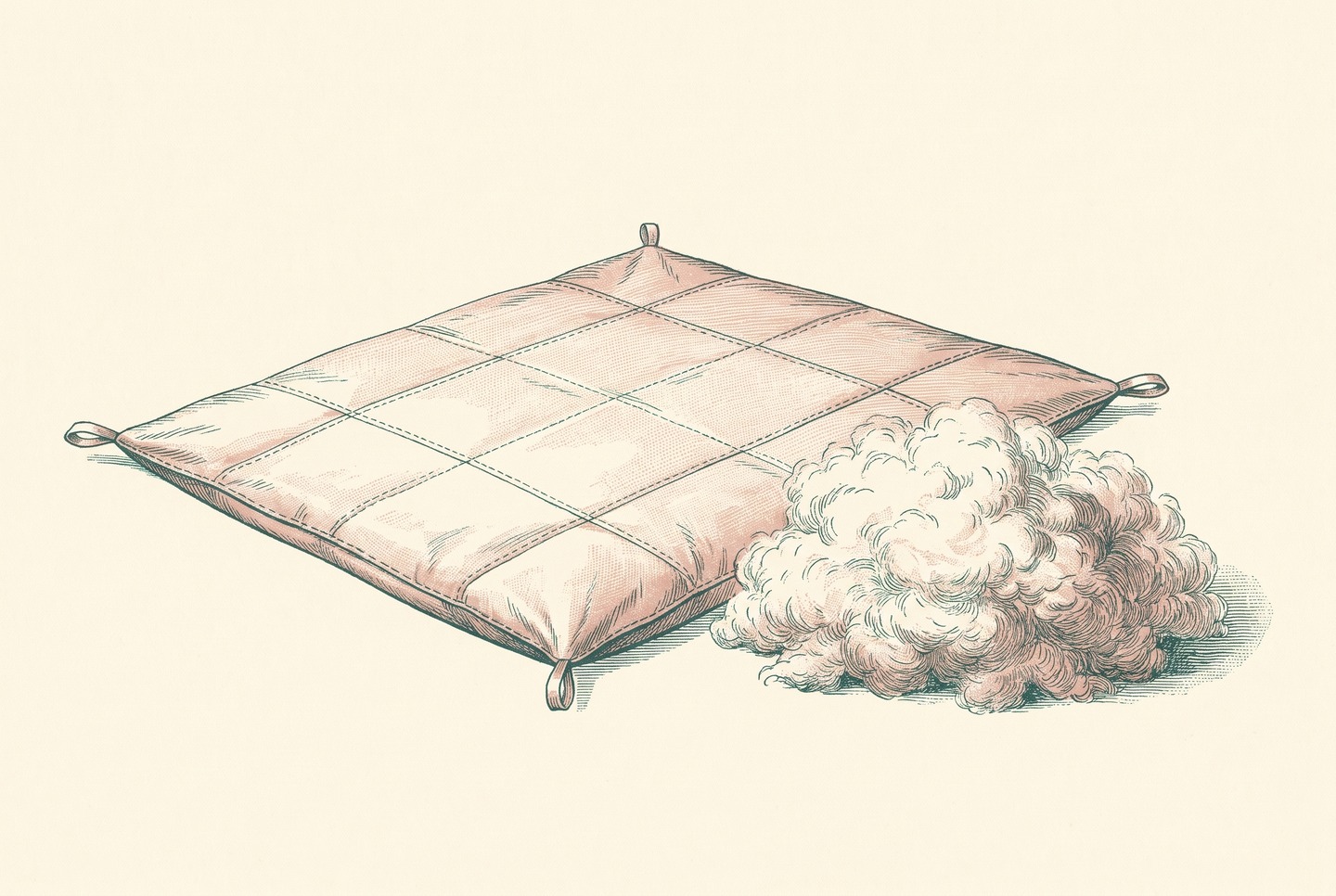
The number counts only what is inside. One bedding seller defines fill weight as the total weight of the down in the item, and product weight as the weight of the entire finished product (Brooklinen). The shell fabric, stitching and corner loops add weight but no warmth, so a product weight always reads higher than the fill weight inside it. Check which of the two a listing gives you before you compare.
You will usually see US sellers state fill weight in ounces for one named size. One full/queen goose down comforter lists 33 ounces of down in a 90 by 90 inch shell (Egyptian Linens). Sellers who follow European practice use GSM. That is the weight of the filling in one square meter, and a higher fill weight means a heavier duvet (Scooms).
On the bed, more fill of the same kind means more warmth and more weight on your body. One down maker says it makes a comforter warmer by adding ounces: its queen summer weight holds 25 oz of fill and its regular weight holds 30 oz (Canadian Down & Feather). Fill weight cannot tell you how much warmth each ounce buys. That part depends on the fiber.
Expect bigger numbers when your fill is cotton rather than down. One organic cotton filled insert describes itself as heavier than down comforters, with a cooler feel (Walmart listing). If you are switching from down to cotton, a higher fill weight is normal. It does not mean a hotter night.
What is the difference between ounces and GSM?
Ounces count all the fill in one size of insert; GSM counts the fill in one square meter, so it does not change with size.
The two units answer different questions. Ounces give the total fill in one insert of one size. GSM tells you how densely that fill is spread across each square meter. Because GSM is measured per area, a twin and a king from one product line usually share a GSM figure, even when their ounce figures differ a lot.
Most American listings use ounces. One US size guide lists its full/queen down insert, 90 by 94 inches, at 28, 35 or 45 oz (Parachute). GSM is common on UK and organic listings, and unlike fill power, which only applies to down, it is used for all fill types (Lili Alessandra).
One trap catches you either way. A GSM figure can mean fill-only weight or total quilt weight including the shell (Bedding Textile Pro). Ask which one you are reading.
The table compares the four numbers you will meet most often. The last column is our judgement.
| Number on the listing | What it measures | Unit you will see | What it cannot tell you |
|---|---|---|---|
| Fill weight in ounces | Total fill in one size of insert | oz or lb | Warmth per ounce, or how sizes compare |
| GSM | Fill in one square meter of duvet | g/m² | Whether the shell is included, unless stated |
| Fill power | Space a fixed weight of down fills | cubic inches per ounce or per 30 g | Anything about cotton, wool or polyester |
| Tog | Heat resistance of the finished duvet | tog | How heavy the duvet feels on you |
How do you convert duvet ounces to GSM?
Multiply ounces by 28.35 to get grams, then divide by the insert's area in square meters; on a 90 by 90 inch queen, each ounce is about 5.4 GSM.
None of the seller pages we read convert between the two, so here is the arithmetic. GSM equals ounces times 28.35, divided by the insert's area in square meters. One square inch is 0.000645 square meters. A 90 by 90 inch queen covers about 5.23 square meters, so each ounce of fill adds about 5.4 GSM.
You can use one shortcut for any size. Multiply the ounces by 43,940, then divide by width times length in inches. Run it backward for GSM to ounces. You will get a close answer, not an exact one. Sellers round their sizes.
Take a real listing. One full/queen down insert at 90 by 94 inches comes in 28, 35 and 45 oz (Parachute).
By our arithmetic on that 90 by 94 inch size, those tiers hold about 145, 182 and 234 GSM. A 300 GSM cotton insert of the same size would hold about 58 oz, or 3.6 pounds. Swap a lightweight down insert for that cotton one and you will have roughly twice the fill lying across you.
We calculated the GSM column below for a 90 by 90 inch queen. No maker publishes it, and your insert's size will move it slightly.
| Fill in a 90 x 90 in queen | GSM, by our arithmetic |
|---|---|
| 20 oz (567 g) | 108 |
| 28 oz (794 g) | 152 |
| 35 oz (992 g) | 190 |
| 45 oz (1,276 g) | 244 |
| 55 oz (1,559 g) | 298 |
| 74 oz (2,098 g) | 401 |
| 92 oz (2,608 g) | 499 |
How much fill weight do you need for each season?
Seller guides put summer fill near 150 to 250 GSM and winter fill near 450 to 600 GSM, but those ranges assume one fill type.
Seasonal ranges exist. Each one assumes a particular fill. One Canadian retailer's guide puts all-season duvets at 300 to 400 GSM, summer duvets at 150 to 250 GSM, and winter duvets at 450 to 600+ GSM (Mattress Miracle). Read those as figures for fills other than down, and the next lines show why.
Down runs much lighter. The US down insert above tops out at 45 oz on a full/queen, about 234 GSM by our arithmetic. Its winter tier falls inside the general guide's summer range. Neither source is wrong; the difference comes from the fiber.
Cotton needs more still. A 300 GSM organic cotton insert is designed for spring, summer and mild autumn, and its seller suggests you layer a blanket over it in colder climates (Amazon listing).
Your bedroom matters too. One UK seller says a lighter duvet suits you when you share a bed, since a second person adds warmth, and when your room is well heated (Richard Haworth). If you run warm, start at the low end of the range for your fill type.
| Season | General guide, GSM (Mattress Miracle) | Down, full/queen 90 x 94 in (Parachute) | Tog (Scooms) |
|---|---|---|---|
| Summer or warm sleepers | 150 to 250 | 28 oz, about 145 GSM | 2.5 to 4.5 |
| All-season | 300 to 400 | 35 oz, about 182 GSM | 9 to 11.5 |
| Winter or cold sleepers | 450 to 600+ | 45 oz, about 234 GSM | 13.5 |
Why is a heavier duvet not always warmer?
Warmth comes from still air trapped by the fill, and some fibers trap more air per gram, so two inserts of equal weight can feel very different.
A duvet keeps you warm by holding still air next to your body. Fibers differ in how much air each gram can hold, so equal weights of two fills can insulate very differently. One UK seller puts it plainly: a heavy duvet does not equal a warmer duvet (Scooms).
Lab work points the same way. A 2023 sleep-comfort paper notes that, for the same filling weight, a down duvet's thermal resistance is significantly higher than that of silk and wool quilts (ScienceDirect, 2023). Synthetic fills are often less insulating than wool, so it takes more synthetic fiber to reach the same tog (Naturalmat).
Adding more of one fill still helps, though often by less than you would expect. In one duvet study, a higher filling amount raised the measured tog from 7.8023 to 8.0201 (study on Academia.edu). Shell fabric and stitching count too. A heat-transfer model of down quilts analyzed filling, shell fabric and quilting parameters as separate influences on thermal resistance (ScienceDirect, 2024).
Weight also does something warmth does not. A heavier insert presses on you more. Heavy duvets feel denser and put more weight on the body (Panda London). You may like that, or not. If you want warmth without it, choose a fill that insulates more per gram.
What does fill power add to the fill weight number?
Fill power grades down by the space a fixed weight of it fills, so it tells you how much warmth each ounce buys; cotton carries no such rating.
Fill power grades down, and only down. The international down bureau's testing rules note that fill power was traditionally reported in cubic inches per ounce, even though 30 g was used when testing (IDFB Testing Regulations). Common values for fill power range from 300 to 900 cubic inches per 30 g (IDFL test summary).
You read the two as a pair. Higher fill power means each ounce fills more space, so fewer ounces reach the same warmth. One maker's queen regular-weight duvets hold either 30 oz of 575 fill power down or 25 oz of 725 fill power down, and because they share a warmth rating, it calls them equally warm (Canadian Down & Feather).
The reverse also holds. A 900 fill power jacket with just 30 grams of down may be less warm than a 450 fill power jacket with 100 grams (Down & Feather Co.). A high fill power on a thin insert does not promise you a warm night.
For cotton, the lesson is short. Fill power is a measure used for down, not feather or polyester (Canadian Down & Feather), and cotton has no rating like it. With cotton, you compare fill weight against other cotton inserts, and you rely on tog wherever a seller gives one.
What is a tog rating and how does it relate to GSM?
Tog is a lab measure of how well the finished duvet resists heat loss, so it is the closest thing to a warmth figure across fills.
Tog is a different kind of number. One tog equals a thermal resistance of 0.1 m²K/W (Bensons for Beds), and a higher tog means a warmer duvet. Tog values follow British Standard BS 4745, and duvets are measured on a togmeter (IDFL). An adult winter duvet usually rates between 10 and 15 tog, and a summer duvet around 4.5 (IDFL).
No fixed GSM matches each tog. One UK seller's 9 tog duvets are 180 GSM, its 4.5 tog duvets 110 GSM and its 2.5 tog duvets 80 GSM (Scooms). Another page from the same seller treats 400 GSM as about 7 to 9 tog (Scooms). GSM figures that far apart for similar warmth only make sense if the fills differ.
US listings rarely give a tog. Tog ratings appear less often than GSM on Canadian labels, mostly from European and British brands (Mattress Miracle). Some natural-fill makers avoid a fixed number altogether. One wool maker describes its warmth as a fluctuating tog equivalency rather than a fixed rating (Devon Duvets).
If you find a tog on a cotton insert, trust it over the fill weight when judging warmth. Tog is measured on the finished duvet. One study found people sleep comfortably when the air under the covers sits at 30 to 33 °C (86 to 91 °F) (ScienceDirect, 2023). Tog tells you how well a duvet holds that heat in.
How do US listings state fill weight?
Of 12 US seller pages we read, ounces were the most common way to state fill, and a full third gave no fill weight at all.
We read 12 US seller pages for full/queen duvet inserts on September 26, 2026: retailer listings, maker product pages and one size guide. We counted only what each page's product text said about fill, and sorted every page into one of three buckets. We did not weigh any duvet. This is a count of published claims, and a figure could sit in an image or tab we could not read.
| How the page states fill | Pages | Which pages |
|---|---|---|
| Fill weight in ounces | 5 | Parachute size guide, 28, 35 or 45 oz; Egyptian Linens, 33 oz; C&W on Amazon, 50 oz; Egyptian Bedding on Amazon, 48 oz; down alternative on Walmart, 50 oz |
| Fill weight in GSM | 3 | cotton insert on Walmart, 300 GSM; cotton insert on Amazon, 300 GSM; down alternative on Bed Bath & Beyond, 150 GSM in the text |
| No fill weight: fill power or a named weight only | 4 | Parachute down duvet, 750 fill power; Crate & Barrel, "medium-weight"; Naturepedic, 750 fill power; Crane & Canopy, 100% cotton fill, no weight given |
Three patterns stood out. Every GSM page came from one maker selling through three retailers, so read that bucket as one seller's habit rather than a market pattern. That maker's Bed Bath & Beyond page gives 500 GSM in its title and 150 GSM in its description. Of the three cotton-filled inserts in the set, two gave GSM and one gave no weight.
What should you check before buying by fill weight?
Before you compare two numbers, confirm they share a size, a fill type, and a meaning: fill only, or fill plus the shell fabric.
You go wrong most often by mixing figures that do not match. Before you set two numbers side by side, run through these checks.
- Same size. You can compare ounces only between inserts of one size. Convert both to GSM if the sizes differ.
- Same fill. Compare cotton with cotton and down with down. If the fills differ, use tog when a seller gives one.
- Fill or whole piece. Confirm whether the figure is fill weight, GSM that includes the shell, or total product weight.
- One consistent figure. If a title and a description disagree, ask the seller which is right before you buy.
- Fill power, for down only. Read it together with the ounce figure, never on its own.
When a listing gives no fill weight, you can ask for it. The number exists before the page does, because manufacturers translate warmth into an enforceable fill weight in grams when they write the product spec (Bedding Textile Pro).
If you are shopping for cotton in particular, our guide to what is inside a cotton duvet insert covers the fill types you will meet. For the low end of the weight range, see what makes a lightweight cotton comforter light. If you are new to the item itself, start with what a cotton duvet is, then come back to the numbers here.
Common questions
Short answers to the fill weight questions a buyer tends to have, each one kept to what the published sources above support.
How many ounces is a lightweight queen duvet?
For down, expect roughly 28 to 33 oz. One US down insert's lightweight full/queen holds 28 oz (Parachute), and one light down comforter's full/queen holds 33 ounces (Egyptian Linens). A cotton insert of similar warmth will weigh more.
What GSM is a good all-season duvet?
It depends on the fill. A general guide puts all-season fill at 300 to 400 GSM (Mattress Miracle), while a midweight full/queen down insert holds only 35 oz (Parachute). Check the fill type before you read the number.
Is a 300 GSM cotton duvet warm enough for winter?
Usually not on its own. One seller designs its 300 GSM cotton insert for spring, summer and mild autumn and recommends layering a blanket in colder climates (Amazon listing).
Does the GSM on a duvet include the cover fabric?
Sometimes. A GSM figure can mean fill-only weight or total quilt weight, fill plus shell (Bedding Textile Pro). If the listing does not say, ask the seller.
Can you convert fill power into GSM or tog?
No. Fill power, GSM and tog are three different measurements, and you cannot convert directly between them (Bedding Textile Pro). Even fill power results from different test systems convert only approximately (IDFL).
Why do European duvets list tog instead of ounces?
The tog scale was set up in the 1940s by the Shirley Institute in Manchester (Scooms), and 13.5 tog is the most commonly used tog in Ireland and the UK (IDFL). In our count of 12 US listings, none gave a tog.
Sources
Reading list for this cotton duvet piece, each title paired with the section where it does its work.
- Brooklinen (brooklinen.com), at work in “What does fill weight measure on a duvet?”.
- Egyptian Linens (egyptianlinens.com), at work in “What does fill weight measure on a duvet?”; “How do US listings state fill weight?”; “Common questions”.
- Scooms (scooms.com), at work in “What does fill weight measure on a duvet?”; “Why is a heavier duvet not always warmer?”; “What is a tog rating and how does it relate to GSM?”.
- Canadian Down & Feather (canadiandownandfeather.com), at work in “What does fill weight measure on a duvet?”; “What does fill power add to the fill weight number?”.
- Walmart listing (walmart.com), at work in “What does fill weight measure on a duvet?”; “How do US listings state fill weight?”.
- Parachute (parachutehome.com), at work in “What is the difference between ounces and GSM?”; “How do you convert duvet ounces to GSM?”; “How much fill weight do you need for each season?”; “How do US listings state fill weight?”; “Common questions”.
- Lili Alessandra (lilialessandra.com), at work in “What is the difference between ounces and GSM?”.
- Bedding Textile Pro (beddingtextilepro.com), at work in “What is the difference between ounces and GSM?”; “What should you check before buying by fill weight?”; “Common questions”.
- Mattress Miracle (mattressmiracle.ca), at work in “How much fill weight do you need for each season?”; “What is a tog rating and how does it relate to GSM?”; “Common questions”.
- Amazon listing (amazon.com), at work in “How much fill weight do you need for each season?”; “How do US listings state fill weight?”; “Common questions”.
- Richard Haworth (richardhaworth.co.uk), at work in “How much fill weight do you need for each season?”.
- Scooms (scooms.com), at work in “How much fill weight do you need for each season?”; “What is a tog rating and how does it relate to GSM?”; “Common questions”.
- ScienceDirect, 2023 (sciencedirect.com), at work in “Why is a heavier duvet not always warmer?”; “What is a tog rating and how does it relate to GSM?”.
- Naturalmat (naturalmat.co.uk), at work in “Why is a heavier duvet not always warmer?”.
- study on Academia.edu (academia.edu), at work in “Why is a heavier duvet not always warmer?”.
- ScienceDirect, 2024 (sciencedirect.com), at work in “Why is a heavier duvet not always warmer?”.
- Panda London (pandalondon.com), at work in “Why is a heavier duvet not always warmer?”.
- IDFB Testing Regulations (nichiukyo.org), at work in “What does fill power add to the fill weight number?”.
- IDFL test summary (alliedfeather.com), at work in “What does fill power add to the fill weight number?”.
- Down & Feather Co. (downandfeathercompany.com), at work in “What does fill power add to the fill weight number?”.
- Bensons for Beds (bensonsforbeds.co.uk), at work in “What is a tog rating and how does it relate to GSM?”.
- IDFL (idfl.com), at work in “What is a tog rating and how does it relate to GSM?”.
- IDFL (idfl.com), at work in “What is a tog rating and how does it relate to GSM?”; “Common questions”.
- Devon Duvets (devonduvets.com), at work in “What is a tog rating and how does it relate to GSM?”.
- C&W on Amazon (amazon.com), at work in “How do US listings state fill weight?”.
- Egyptian Bedding on Amazon (amazon.com), at work in “How do US listings state fill weight?”.
- down alternative on Walmart (walmart.com), at work in “How do US listings state fill weight?”.
- down alternative on Bed Bath & Beyond (bedbathandbeyond.com), at work in “How do US listings state fill weight?”.
- Parachute down duvet (parachutehome.com), at work in “How do US listings state fill weight?”.
- Crate & Barrel (crateandbarrel.com), at work in “How do US listings state fill weight?”.
- Naturepedic (naturepedic.com), at work in “How do US listings state fill weight?”.
- Crane & Canopy (craneandcanopy.com), at work in “How do US listings state fill weight?”.
- IDFL (idfl.com), at work in “Common questions”.