What size washer does a cotton duvet need, and how do you dry it all the way through?
Updated .
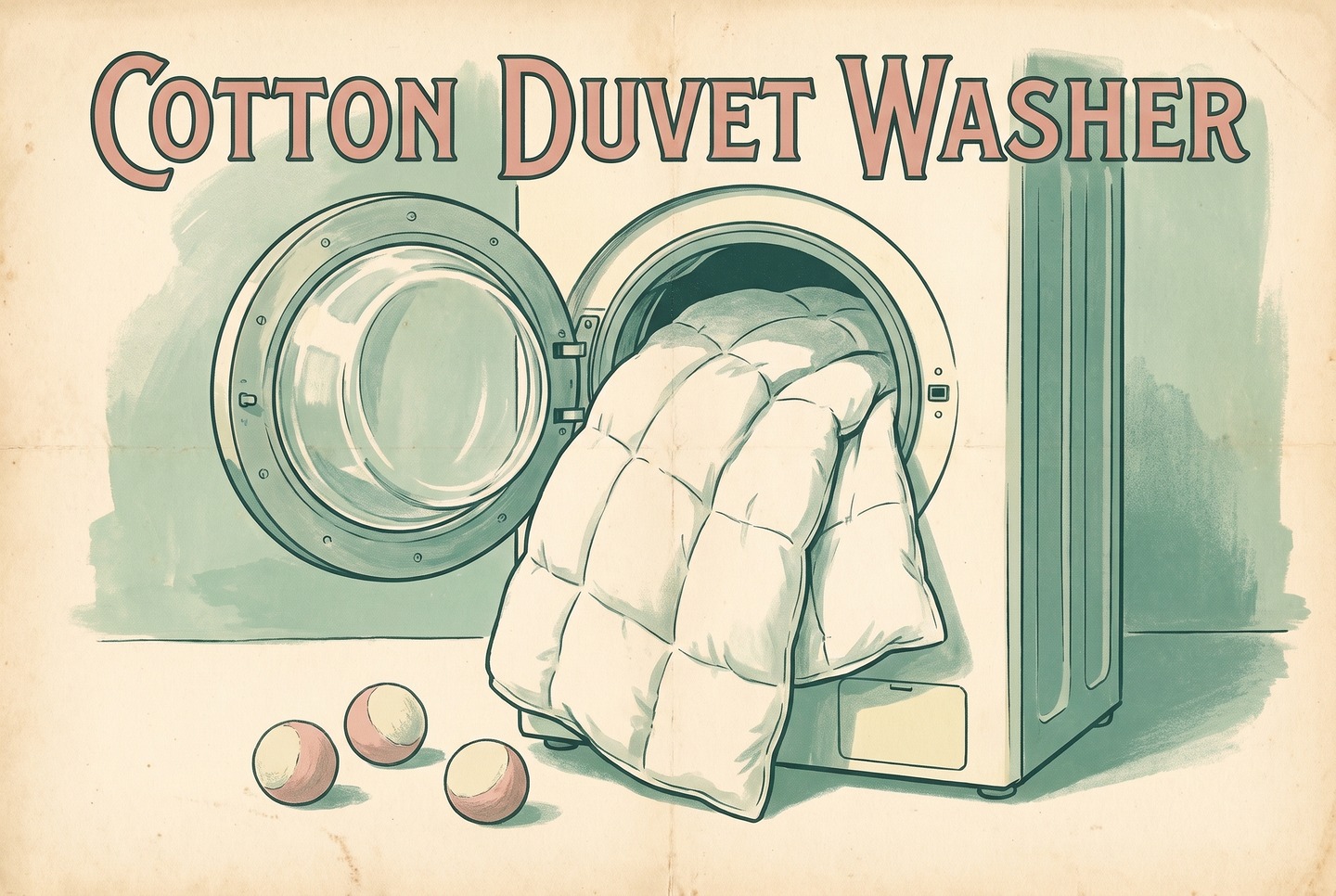
On laundry day a cotton duvet behaves like a very large towel. Cotton fill soaks up water. An insert that goes into your washer light comes out heavy. The batting inside holds that water for hours after the shell feels ready. Two things decide whether the wash goes well: how big the drum is, and how patiently you dry the duvet afterward. Washers with a capacity of more than 4.5 cubic feet fit a king-size comforter in Consumer Reports testing. Plan for a long day.
Short answer: For a queen or king, use a front-loader above 4.5 cubic feet, or an impeller top-loader of 5.0 cubic feet or more. Wash the duvet alone on a gentle cycle with less soap than usual and an extra rinse. Then dry it on low heat with dryer balls, taking it out to shake it every 30 to 40 minutes. Expect this to take hours. You can stop only when the middle feels as warm and light as the edges. If your machine is smaller, go to a laundromat.
This guide is for: anyone with a cotton-filled comforter or duvet insert who wants to wash it at home without damaging the fill or the machine.
Key Takeaways
Three numbers carry this page: the washer size that fits, what six seller pages print, and the water heat that left no live dust mites in bedding.
- A queen or king cotton duvet needs a washer above 4.5 cubic feet. Washers with a capacity of more than 4.5 cubic feet fit a king-size comforter in Consumer Reports testing. By comparison, standard and high-efficiency top-loading washing machines normally measure 3 to 3.5 cubic feet (House Digest).
- We read six product pages for cotton-filled duvets, and 0 of them named a washer size. Only 1 named a machine type, and 1 offered dry cleaning instead. The full count is in the section on what makers tell you.
- Wash water at 130°F (55°C) or hotter left no live dust mites in a 1992 study. In the same study a cold cycle left most live mites in the bedding but cut the allergen by more than 90% (Mission: Allergy summary of McDonald and Tovey). Allergy specialists often give that hot-water line as 55°C or 130°F (Allergy Cosmos).
Of these three, the drying figure is the one to keep in mind. A duvet that comes out of the dryer with a wet core can turn musty once it is stored.
On This Page
Eight questions, in the order you would meet them on laundry day, from fitting the duvet in the drum to checking that the middle is dry.
Each section opens with a short answer, and the evidence follows. The common questions at the end cover how often to wash, covers, softener, shrinkage, line drying and musty smells.
Why is a cotton duvet harder to wash than a down or synthetic one?
Cotton fill drinks water and holds it deep in the batting, so a cotton duvet gets far heavier in the wash and slower to dry than synthetics.
Water makes the difference. Cotton fiber takes up water readily and gives it back slowly, and a duvet insert is several pounds of loose fiber inside a shell. If your duvet is filled with polyester, it will dry more quickly (AOL), which is why the synthetic-duvet advice you find online undersells how long cotton takes.
A worked example makes the scale clearer. One cotton-filled insert is sold at Full/Queen (88"×92") with a fill rated at 300 GSM (Delara on Amazon). Multiplying that area by that fill weight puts the cotton inside at about 3.5 lb. That is before the shell. The federal dryer test prepares its load so that the moisture content is 57.5 percent ±0.33 percent of its dry weight (eCFR, Appendix D2). At that level, the fill alone would carry about 2 lb of water. That water has to come out.
The weight is only half the problem. Water sits deepest in the thickest batting, and that is the last place the dryer's heat reaches. That is why one maker's care text says plainly: "Don't leave damp." (Whisper Organics). If you want to know how fill weight changes what you are handling, see our guide to what duvet fill weight means in ounces and GSM.
What washer capacity does a cotton duvet need?
A queen or king cotton duvet needs a washer above 4.5 cubic feet. Smaller drums can take a twin if the duvet still tumbles freely.
US washers list their capacity in cubic feet, and that one number tells you whether the duvet will have room to move. Above 4.5 cubic feet is the line for a king, based on Consumer Reports testing. For scale, a large washing machine with an extra-large 6.2-cubic-foot capacity can hold 17 thick, full-sized bath towels, while compact washers, which have a claimed capacity of 2.7 cubic feet or less, can fit about six (Consumer Reports). Standard front-loading washers generally measure up to 4.5 cubic feet (House Digest).
You can check your own machine in a minute. If you have to push or compress your comforter to fit it into the washer, the machine is too small (Wayfair). Room to move is the whole test. Water has to flow through the batting. A jammed drum sends you home with a clean shell around a core that was never washed.
The table below is our judgement, built on those published capacities. No cotton duvet maker publishes anything like it.
| Washer capacity | Published basis | Our judgement for a cotton duvet |
|---|---|---|
| 2.7 cu ft or less | Compact class (Consumer Reports) | Twin at most, and only if it tumbles freely |
| 3 to 3.5 cu ft | Typical top-loader (House Digest) | Twin; a full or queen will likely jam |
| Up to 4.5 cu ft | Standard front-loader (House Digest) | Full or queen washed alone; king is borderline |
| More than 4.5 cu ft | Fit a king in tests (Consumer Reports) | Queen or king, washed alone |
Can a top-loading washer with an agitator handle a cotton duvet?
A central agitator can drag and tear a heavy wet duvet. A front-loader or an impeller top-loader of 5 cubic feet or more is the safer choice.
The type of drum matters almost as much as the size. A top loader with agitator is too rough. The agitator can damage the baffles (internal stitching that keeps fill evenly distributed) (Truuce). A wet cotton duvet wraps around the post, and the seams take the strain.
Front-loaders avoid that problem. They don't have a central agitator, which means more room for bulky items to tumble freely. High-capacity top-load washers with an impeller (instead of an agitator) can also handle king comforters well. Look for models with 5.0 cubic feet or more (Wayfair). One maker of a cotton-filled insert is stricter: machine wash on the gentle cycle in cold water using a front-loading machine only (Delara on Amazon).
If your machine has an agitator, a laundromat front-loader is the better bet. Whichever machine you use, cut the soap. One guide says to add only one-third to half of the laundry detergent amount you'd use (AOL). Run an extra rinse with no detergent to flush out any remaining soap (Doze). Leftover soap also makes a duvet stiff. The last question on this page explains the fix.
What do cotton duvet makers tell you about washing and drying?
We read six cotton-fill product pages. Most allow home washing, none gives a washer size, and one offers dry cleaning as well.
We read six seller product pages for cotton-filled comforters and duvet inserts on September 27, 2026. Each page went into one of three groups, based on what its care text says about the machine. The table counts the words each seller publishes, and only those.
| What the page states about the machine | Pages | Which pages |
|---|---|---|
| Machine washable, and names a machine type | 1 | Delara on Amazon |
| Machine washable, with no machine size or type given | 4 | Delara, Whisper Organics 240 GSM, Whisper Organics heavier comforter (page since taken down), Whisper Organics 240 GSM at Natural Linens |
| A route other than the home washer: dry cleaning offered | 1 | Crane & Canopy |
Two things stand out. The first is that none of the six gives a capacity in cubic feet. Delara's Amazon listing comes closest by naming a machine type. The rest tell you the duvet is machine washable and say nothing about whether your machine is big enough. Two products appear twice. Each shows up once on the maker's site and once at another seller.
The second is that the drying advice is looser than the washing advice. Five pages let you pick between the dryer and air drying. Only the Whisper Organics text, which appears on three of the pages, warns you directly against leaving the duvet damp. Crane & Canopy's page reads "Machine wash cold on delicate or dry clean."
What water temperature should you use for a cotton duvet?
Follow the label first. In a 1992 study, 130°F water left no live mites, while a cold wash cut most allergen but left mites alive.
Start with your label, because the shell and stitching set the limit. Delara says "Machine wash cold, gentle cycle." Whisper Organics allows "warm or cool."
The 1992 study by McDonald and Tovey shows what you give up with cold water. No mites survived wash water at 55°C or hotter, while a cold cycle cut the allergen by more than 90% and left most live mites in place (Mission: Allergy). In US terms, allergy specialists often give that line as hot water at 55°C or 130°F (Allergy Cosmos). A 1999 study by Mason and colleagues tumble dried whole duvets in a home dryer. The heat left few mites alive, but it did not remove the allergen already in the duvets, so they still needed washing (Mission: Allergy).
| Treatment | What the study found | Study |
|---|---|---|
| Wash water 130°F (55°C) or hotter | No live mites left | McDonald and Tovey, 1992 |
| Cold wash | Allergen down more than 90%; most live mites stayed | McDonald and Tovey, 1992 |
| Dry cleaning | Few or no live mites left; allergen not reduced | McDonald and Tovey, 1992 |
| Hot tumble drying of whole duvets | Few live mites left; allergen not removed | Mason et al., 1999 |
So the right temperature depends on why you are washing. A cold, label-safe wash still removes most of the allergen. If you need to control dust mites, our judgement is to wash the cover hot and often. Covers are thinner and dry in one cycle.
How do you dry a cotton duvet all the way through?
Use low heat, dryer balls and several cycles, pulling the duvet out to shake and turn it. Finish on a rack if the center still feels cool.
Drying is where a cotton duvet is saved or spoiled. The Sleep Foundation's advice is to dry the duvet thoroughly in a large dryer on low heat, adding clean tennis balls or dryer balls to help fluff the filling. It also says to make sure the duvet is completely dry before using or storing it, to prevent mildew and clumping (Sleep Foundation). Every cotton-fill page we read that gives a dryer setting says low.
Be ready to wait. One organic comforter seller warns that its comforter may need two dryer cycles, or one cycle plus air drying (Organic Favorite). That product has synthetic fill. In our judgement a cotton duvet dries more slowly still. Pause every 30 to 40 minutes: one guide says to shake out the insert and redistribute the stuffing (Doze). Another seller's care text says to tumble dry on low with dryer balls or clean tennis balls and to make sure the comforter is completely dry before storing (Organic Textiles).
A machine's idea of dry matters too. The federal test runs a load until the moisture content of the test load is between 1 and 2.5 percent of the bone-dry weight (eCFR, Appendix D2). Our judgement is that an auto-dry sensor can reach that reading from the shell while the core is still wet. Timed low-heat cycles keep you in charge.
How can you tell a cotton duvet is dry in the middle?
A damp core feels cool and heavy even when the shell is dry. Check the thickest squares and the seams, then give it another hour if unsure.
The shell dries first. That can fool your fingertips. If the insert is not done, the fix is to keep it in the dryer on low heat or air dry it on a drying rack until there's no coolness or weight in the middle (Doze). Press your palm flat into the thickest part and hold it there for a few seconds. Damp cotton feels cooler than the dry fabric around it.
Know where to check. Folded batting builds up at the seams and corners, and the middle of each quilted square is the thickest point. Our guide on how baffle box, sewn-through, and channel comforters differ shows where the fill sits in each construction. If one area feels cooler or heavier than the rest, run another low cycle.
Guessing wrong costs you. The Sleep Foundation ties incomplete drying to mildew and clumping (Sleep Foundation). Truuce puts it this way: "Incomplete drying leads to mildew and that musty smell next October." An extra hour costs you less than storing a duvet with a wet core. If you are not sure, drape it over a rack or two chairs in a room with moving air overnight, and flip it once before bed.
When should you use a laundromat or skip washing altogether?
Go to a laundromat when your washer is under 4.5 cubic feet or has an agitator. One cotton-filled insert is sold with no wash at all.
A laundromat makes sense in three cases. Your washer is 4.5 cubic feet or less for a queen or king, it has a central agitator, or your dryer is too small for the duvet to tumble. That size line comes from Consumer Reports testing, where washers above 4.5 cubic feet fit a king. At a laundromat you get a large-capacity front-loading machine, which gives the insert room to agitate and rinse freely (Truuce). Their dryers help too. If your home washer is too small, consider using a laundromat or professional cleaning service (Puffy).
Some cotton duvets are not meant to go in a washer at all. Qbedding asks you not to wash its cotton-filled winter insert and to wash the duvet cover routinely instead (Qbedding). Check your own label before you try.
Whatever you own, a washable cover means you wash the insert less often. You can wash the cover every week and the insert rarely. Our guide to what is inside a cotton duvet insert explains how different constructions change the care you give them.
Common questions
Short answers on how often to wash, whether to use a cover, dryer sheets, shrinkage, drying outdoors and what to do with a musty smell.
How often should you wash a cotton duvet insert?
Duvets should be washed every 6 to 12 months (Sleep Foundation). A cover stretches the gap between washes. If you see stains or smell sweat, wash it sooner.
Do you need a duvet cover?
A cover is the cheapest protection your insert can have. Delara's care text says "Use a duvet cover for longevity." (Delara). You can wash the cover hot in a normal machine.
Should you use fabric softener or dryer sheets?
No. Delara's care text says to "Avoid bleach and fabric softeners." (Delara). Wool dryer balls fluff the fill and leave no coating behind.
Will a cotton duvet shrink in the dryer?
Low heat keeps the risk small. It is also what makers specify. Every cotton-fill page we read that gives a dryer setting says low. Our advice is to keep hot cycles for the cover.
Can you dry a cotton duvet outside on a line?
Yes, if your label allows it. Whisper Organics lists a low tumble dry, removed promptly, or line drying. Spread it across two lines, flip it every few hours, then give it a short low tumble.
What should you do if a washed duvet smells musty?
The usual cause is a core that never dried. If it feels stiff, that is soap left in the fill, and Doze advises you to rewash the insert with no detergent, using only water on a gentle cycle, and do an extra rinse cycle. After that, dry it longer.
Sources
Reading list for this cotton duvet piece, each title paired with the section where it does its work.
- Consumer Reports (consumerreports.org), at work in “Key Takeaways”; “What washer capacity does a cotton duvet need?”; “When should you use a laundromat or skip washing altogether?”.
- House Digest (housedigest.com), at work in “Key Takeaways”; “What washer capacity does a cotton duvet need?”.
- Mission: Allergy summary of McDonald and Tovey (missionallergy.com), at work in “Key Takeaways”; “What water temperature should you use for a cotton duvet?”.
- Allergy Cosmos (allergycosmos.co.uk), at work in “Key Takeaways”; “What water temperature should you use for a cotton duvet?”.
- AOL (aol.com), at work in “Why is a cotton duvet harder to wash than a down or synthetic one?”; “Can a top-loading washer with an agitator handle a cotton duvet?”.
- Delara on Amazon (amazon.com), at work in “Why is a cotton duvet harder to wash than a down or synthetic one?”; “Can a top-loading washer with an agitator handle a cotton duvet?”; “What do cotton duvet makers tell you about washing and drying?”.
- eCFR, Appendix D2 (ecfr.gov), at work in “Why is a cotton duvet harder to wash than a down or synthetic one?”.
- Whisper Organics (whisper-organics.com), at work in “Why is a cotton duvet harder to wash than a down or synthetic one?”; “What do cotton duvet makers tell you about washing and drying?”.
- Wayfair (wayfair.com), at work in “What washer capacity does a cotton duvet need?”; “Can a top-loading washer with an agitator handle a cotton duvet?”.
- Truuce (truuce.com), at work in “Can a top-loading washer with an agitator handle a cotton duvet?”; “When should you use a laundromat or skip washing altogether?”.
- Doze (dozebedding.com), at work in “Can a top-loading washer with an agitator handle a cotton duvet?”; “How do you dry a cotton duvet all the way through?”; “How can you tell a cotton duvet is dry in the middle?”.
- Delara (delarahome.com), at work in “What do cotton duvet makers tell you about washing and drying?”; “Common questions”.
- Whisper Organics 240 GSM at Natural Linens (naturallinens.com), at work in “What do cotton duvet makers tell you about washing and drying?”.
- Crane & Canopy (craneandcanopy.com), at work in “What do cotton duvet makers tell you about washing and drying?”.
- Sleep Foundation (sleepfoundation.org), at work in “How do you dry a cotton duvet all the way through?”; “How can you tell a cotton duvet is dry in the middle?”; “Common questions”.
- Organic Favorite (organicfavorite.com), at work in “How do you dry a cotton duvet all the way through?”.
- Organic Textiles (organictextiles.com), at work in “How do you dry a cotton duvet all the way through?”.
- eCFR, Appendix D2 (law.cornell.edu), at work in “How do you dry a cotton duvet all the way through?”.
- Puffy (puffy.com), at work in “When should you use a laundromat or skip washing altogether?”.
- Qbedding (qbedding.com), at work in “When should you use a laundromat or skip washing altogether?”.