Is an Egyptian cotton comforter Egyptian cotton all the way through?
Updated .
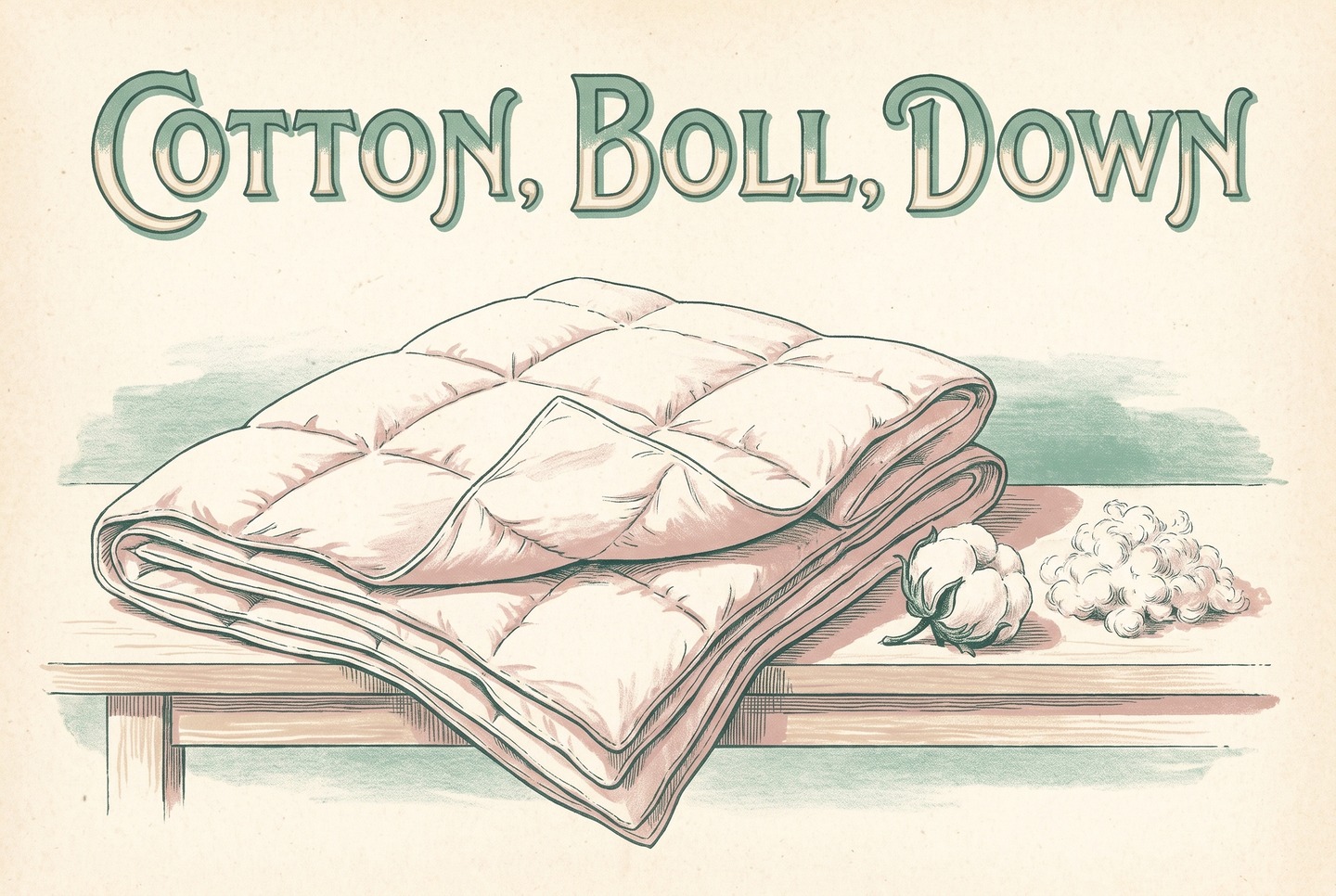
Most comforters sold as Egyptian cotton are made of two materials sewn together. The shell is woven cotton, and the fill is usually something else. The product name tends to describe only the shell, which is the part you touch but not the part that keeps you warm.
Short answer: Usually not. The Egyptian cotton claim normally covers the outer shell, and the fill is usually down, feathers or a synthetic fiber. Of the 11 seller pages we read, 8 named a down or down and feather fill under an Egyptian cotton shell. The shell claim can fail too. In 2016 Target found a supplier had used non-Egyptian cotton in its sheets for about two years. Before you buy, read the fill line, then look for proof of origin.
This guide is for: people in the United States weighing an Egyptian cotton comforter or duvet insert who want to know what the label covers before they pay.
Key Takeaways
Three points carry most of the weight here, and each one comes with a figure you can check against the source linked in the body below.
- 8 of the 11 seller pages we read on September 26, 2026 named a down or down and feather fill, so the Egyptian cotton claim on those pages described only the shell.
- About 750,000 sheets and pillowcases sold at Target as Egyptian cotton between 2014 and 2016 were made from another cotton, which is why a label on its own proves nothing.
- 0 of the 11 pages we read on the same date mentioned a Cotton Egypt Association seal or a DNA test.
On This Page
Eight questions, in the order most people ask them, from what the label covers to how you check a comforter before you pay for it.
What does the Egyptian cotton label on a comforter describe?
On the listings we read, the Egyptian cotton claim covers the outer shell fabric. The fill inside is a separate fiber with its own label.
A comforter is a fabric shell filled with down, feathers, polyester or cotton, then stitched so the fill stays spread out. Sellers lead with the shell because it is what your skin touches. The fill decides the warmth, the weight and how you wash it. It is often a different fiber entirely.
US labeling rules keep the two parts apart. The Federal Trade Commission's guide to the Textile Act says that when fillings are used for warmth, "their fiber must be disclosed as a sectional disclosure" (FTC). On a compliant law label, you will see the shell and the fill on separate lines. The rules themselves show you "Filling: 100% Cotton" as a sample label line (16 CFR Part 303).
The agency also limits how loose a fiber claim can be. It allows a 3% tolerance on fiber content, but "There is no tolerance for a 100% claim" (FTC). A shell sold as 100% Egyptian cotton should contain nothing else.
That rule checks the fiber, not the farm. A fiber-content line can say "cotton" truthfully without telling you where the cotton grew. So the word "Egyptian" needs its own evidence. You should ask for it. Our guide Is a 100% cotton comforter cotton inside, too? covers the same split between shell and fill for any cotton comforter.
What is inside most Egyptian cotton comforters?
Usually down, feathers or a synthetic fiber. Of the 11 seller pages we read, 8 named a down or down and feather fill under the shell.
The fill is the part that keeps you warm, and on these listings it is rarely the fiber named in the product title. Each fill changes the weight, the warmth and how you wash the comforter. Down leads on the pages we read.
Goose and duck down appear on their own, and one seller blends 75% down with 25% feather under an Egyptian cotton shell (Egyptian Linens). Feathers are heavier than down. A higher feather share usually gives you a heavier, flatter comforter for the same warmth.
"Down alternative" is the phrase you need to decode. One seller's down alternative comforter with a cotton shell lists its fill as microfiber, a synthetic (Down Cotton). When you see that phrase, expect a synthetic fill unless the page says otherwise.
The last column below is our judgement from the labels and care lines we read, not a figure any maker publishes.
| Fill | How the label names it | What it means for you |
|---|---|---|
| Down | Goose or duck down, often with a fill power | Light for its warmth; often dry clean only |
| Down and feather | A split such as 75% down, 25% feather | Heavier and flatter as feathers rise |
| Synthetic | Down alternative, microfiber, polyester | Often machine washable; read the care line |
| Cotton | Cotton fill or cotton batting | Flatter and denser; an all-cotton bed |
Want cotton inside too? Search for cotton fill by name, because the Egyptian cotton label on the shell will not tell you what sits underneath it. To compare fills before you choose a shell, see What is inside a cotton duvet insert, and how do you pick one?
What do Egyptian cotton comforter listings say about the fill?
We read 11 seller pages. Most named the fill clearly, two narrowed their own claim, and two used wording that promises nothing about origin.
We read 11 seller and retailer pages for Egyptian cotton comforters on September 26, 2026, and sorted each one by what it lets you verify. This is a count of what the pages state. The comforters we pick were bought and handled. Nothing here was weighed or tested.
- Clear, 7 pages: the shell is named as Egyptian cotton and the fill fiber is stated.
- Narrowed by the page itself, 2 pages: one page's twin size uses a plain cotton shell, and one page's headline says Egyptian cotton while its description says only cotton.
- Origin not claimed, 2 pages: retailer results that say "Egyptian quality," which describes a feel, not a place.
| Page | Fill it states | Bucket |
|---|---|---|
| Down Cotton, down alternative | Microfiber | Clear |
| Egyptian Linens, dobby | 75% down, 25% feather | Clear |
| Egyptian Linens, solid sateen | Duck down | Clear |
| Royal Egyptian Bedding, twin | Goose down | Clear |
| Royal Egyptian Bedding, white | Goose down | Clear |
| Royal Egyptian Bedding, black | Goose down | Clear |
| Royal Egyptian Bedding, oversized | Goose down | Clear |
| Egyptian Linens, 500 thread count | Duck down | Narrowed |
| Luxury Egyptian Linens, 1200 thread count | Goose down | Narrowed |
| Wayfair, down comforter results | Mixed | Origin not claimed |
| Wayfair, cotton filled results | Mixed | Origin not claimed |
Eight of the 11 named down or a down and feather mix. None mentioned a Cotton Egypt Association seal or a DNA test. One page cited a certificate for harmful substances. That tells you nothing about where the cotton grew.
Can a comforter labeled Egyptian cotton be fake?
Yes. In 2016 a major US retailer found a supplier had swapped in other cotton for two years, and a label alone could not have told you.
It has happened on a large scale. In August 2016 Target said a vendor had "substituted another type of non-Egyptian cotton" in its Fieldcrest 500 thread count Egyptian cotton sheets between August 2014 and July 2016 (Target, 2016). About 750,000 sheets and pillowcases were affected (Top Class Actions, 2016). Walmart and Bed Bath & Beyond dropped the same maker's sheets soon after (Associations Now, 2016).
Those were sheets, but the lesson carries over. Comforter shells use the same cotton. Target's own statement shows the sheets were still cotton, just not Egyptian (Target, 2016). The fiber line on the label was accurate. The origin claim was not.
The trade body's executive director said around the same time that samples taken around the world showed "a big percentage of what's labelled 'Egyptian cotton' is not" (Home Textiles Today). No figure came with that statement. A trade report the same year said the association estimated that some 90% of products labeled Egyptian cotton were not genuine (Retail Dive, 2016). That is the association's estimate, not a published survey, so read it as a warning rather than a measured rate.
Your takeaway is simple. A label is a claim, and a claim needs a paper trail. A seller using genuine Egyptian cotton should be able to show you a certificate or a licensed logo. If a seller cannot, you are paying for a word.
How is real Egyptian cotton verified?
The trademark body for Egyptian cotton licenses a logo and runs DNA tests on fiber. None of the 11 listings we read mentioned that seal.
The trade body that licenses the Egyptian cotton name is the Cotton Egypt Association, and the mark it grants after testing is the Egyptian Cotton Gold Seal. The seal belongs to a DNA-based program "designed to rid the supply chain of falsely labelled goods" (Home Textiles Today). The DNA method was developed at Egypt's Cotton Research Institute. The association also said it was pulling home textiles labeled Egyptian from store shelves and sending them to an outside lab for testing.
A seal beats a product title.
It is not a guarantee. When the association launched DNA testing in 2016, the "first company to receive a gold seal" was the same supplier Target dropped months later (New Equipment Digest, 2016).
So use the seal as a filter. Then ask one more question. You can ask which licensed mill made the shell and whether the certificate covers that product line. In 2016 JCPenney said any product it labeled Egyptian cotton had to come with an association certificate (Fortune, 2016). You can hold a small online seller to the same standard. A seller with real paperwork will usually be glad you asked.
Is all Egyptian cotton extra-long staple?
No. Longer fibers spin into a smoother, softer shell for you to sleep under, and Egypt grows both long and extra-long staple types.
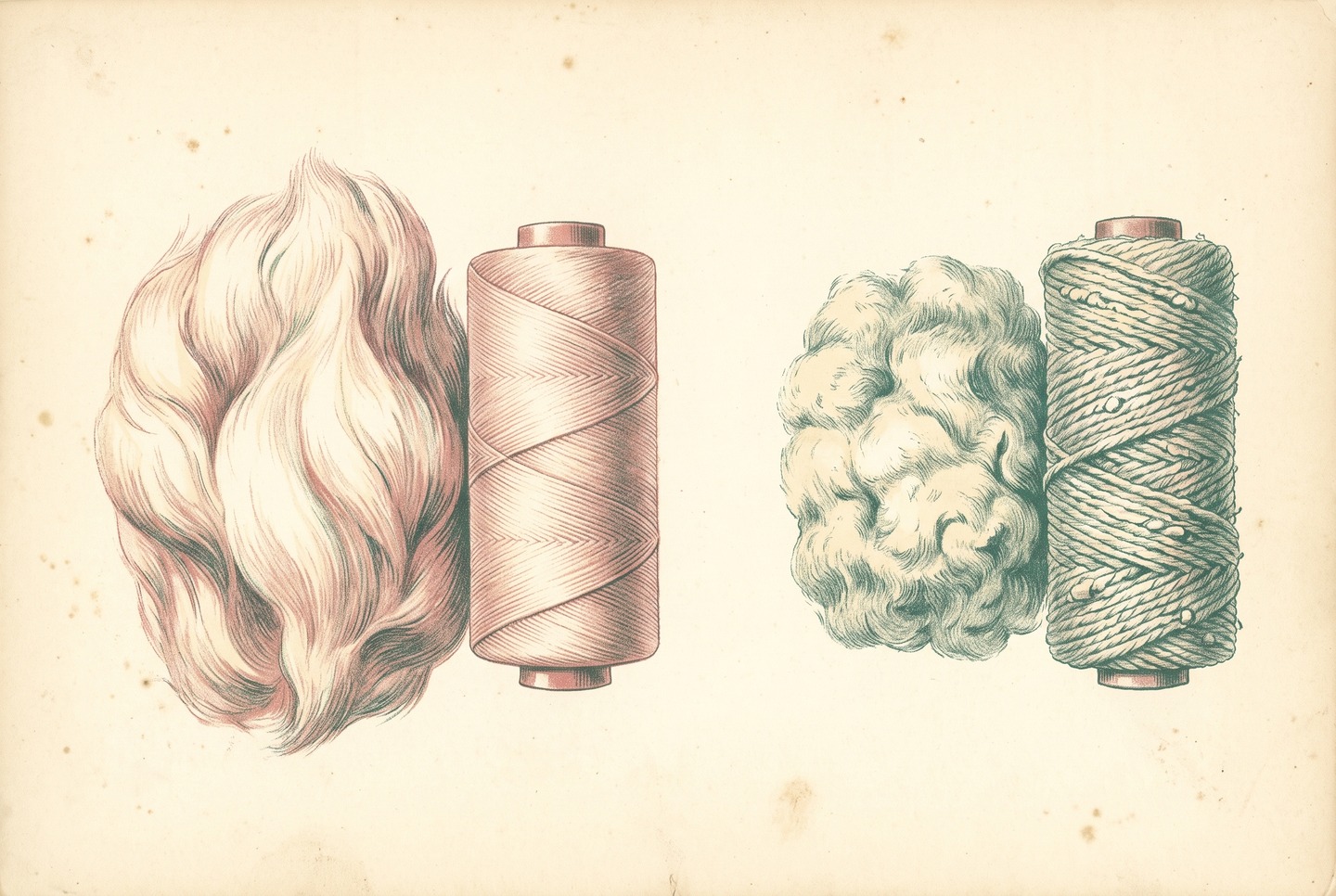
Staple length is the length of a single fiber. The longer each fiber, the finer and smoother the yarn you can spin from it, and a shell woven from finer yarn feels smoother against your skin. In the US, cotton must be 1-3/8 inches or longer to count as extra-long staple (USDA rule, Federal Register, 2004). Egypt grows both kinds.
| Staple class | Fiber length | Where you meet it |
|---|---|---|
| Extra-long staple | 1-3/8 in. or longer | Giza 45, 87, 92, 93, 96 |
| Long staple | Shorter than 1-3/8 in. | Giza 86, 94, 95, 97, 98 |
| Upland | Mostly shorter than long staple | Most cotton grown |
The extra-long staple threshold matches the definition published by CottonWorks (CottonWorks). The Giza groupings come from Egypt's Cotton Research Institute (World Cotton Day, 2022).
The institute says its Delta long staple types, Giza 86, 94 and 97, are preferred for export and by spinners making fine yarns (World Cotton Day, 2022). So a genuine Egyptian cotton shell can easily be long staple. For you, that still means a smooth shell to sleep under, just not always the finest grade the name suggests.
If a listing says Egyptian cotton and nothing more, you cannot tell which class you are getting. A named Giza type, or the words extra-long staple, tells you more about how the shell will feel when you sleep under it.
Is a comforter made in Egypt made of Egyptian cotton?
Not necessarily. A made-in label names where the comforter was sewn, while Egyptian cotton names where the fiber grew, and the two can differ.
US law requires most textiles to show a country of origin for the finished product (FTC). That line tells you where the comforter was made. It does not tell you where the fiber grew.
The two facts can split even in honest bedding. The Gold Seal program certifies makers outside Egypt too, and one early certificate went to an Indian company for its bed linens (Home Textiles Today). That is Egyptian fiber made up elsewhere. The reverse can happen too, because the made-in line covers only where the product was finished, not where its cotton came from.
Egypt's own Cotton Research Institute says its Delta long staple types are preferred for export (World Cotton Day, 2022). So the country on your law label and the country where your cotton grew can easily be two different places.
Treat the two lines as separate facts. If you care where the cotton grew, look for the seal or certificate described in the section on verification, not the country printed on the tag. That paperwork is the origin proof you can check yourself.
How do you check an Egyptian cotton comforter before you buy?
Read the fill line first, then the shell line, then look for a seal or ask for proof. Price and thread count tell you less than those three.
Go down the listing in this order. Stop at the first line where the answer fails, since a good answer further down cannot make up for it.
| What to check | A good answer | What it cannot prove |
|---|---|---|
| Fill line | Fiber named, weight in ounces | Warmth in your bedroom |
| Shell line | Egyptian cotton in every size | Staple length |
| Staple or Giza type | Extra-long staple or a named Giza | Origin, on its own |
| Origin proof | Licensed logo or certificate | That this batch passed |
| Care line | Matches the fill | Durability |
Fill weight only compares like with like. One seller's lightweight down comforter holds 36 ounces of down in a 90 by 90 inch full/queen (Egyptian Linens). Down and polyester pack differently. You should compare ounces only between comforters that use the same fill.
Thread count tells you how tightly the shell is woven. It says nothing about where the cotton grew. Skip any listing that dodges the fill question, because a seller who hides the inside is unlikely to prove the outside. If you still like the comforter, email the seller and ask for the certificate before you order.
Common questions
Short answers to the six questions that come up most often after the main guide, each one kept to what a source or a listing states.
Is Egyptian cotton the same as Pima cotton?
No, though both can be extra-long staple. Egyptian Giza, Peruvian Pima and Sea Island are all extra-long staple types, and the name Pima was given to that cotton as it was developed in the US (Home Textiles Today). The difference is where it grew and from which seed.
Does "Egyptian quality" mean the cotton came from Egypt?
No. It describes a feel the seller claims, not a place. One result we read used the phrase for a cotton and polyester blend shell (Wayfair).
Does a higher thread count mean real Egyptian cotton?
No. Thread count measures how tightly the shell is woven, not where its fiber grew. The Target sheets found to contain non-Egyptian cotton were sold as 500 thread count (Target, 2016).
Can you machine wash an Egyptian cotton down comforter?
Check the care line first. One seller of Egyptian cotton down comforters recommends "only dry cleaning as water might ruin the down" (Royal Egyptian Bedding). Microfiber versions are often sold as machine washable, though one seller still recommends dry cleaning (Down Cotton).
How heavy should a queen Egyptian cotton comforter be?
It depends on the fill. One seller's lightweight down comforter lists 36 ounces of down in the full/queen and 40 ounces in the king/cal king (Egyptian Linens). You should compare weights only within one fill type.
Is an Egyptian cotton comforter also organic?
Only if the label says so and a certificate backs it up. Where cotton grew and how it was farmed are separate claims, so one tells you nothing about the other. Our guide Is an organic cotton comforter organic on the inside? covers the organic side.
Sources
Reading list for this cotton duvet piece, each title paired with the section where it does its work.
- FTC (ftc.gov), at work in “What does the Egyptian cotton label on a comforter describe?”.
- 16 CFR Part 303 (ecfr.gov), at work in “What does the Egyptian cotton label on a comforter describe?”.
- FTC (ftc.gov), at work in “What does the Egyptian cotton label on a comforter describe?”.
- Egyptian Linens (egyptianlinens.com), at work in “What is inside most Egyptian cotton comforters?”; “What do Egyptian cotton comforter listings say about the fill?”.
- Down Cotton (downcotton.com), at work in “What is inside most Egyptian cotton comforters?”; “What do Egyptian cotton comforter listings say about the fill?”; “Common questions”.
- Egyptian Linens, solid sateen (egyptianlinens.com), at work in “What do Egyptian cotton comforter listings say about the fill?”; “How do you check an Egyptian cotton comforter before you buy?”; “Common questions”.
- Royal Egyptian Bedding, twin (royalegyptianbedding.com), at work in “What do Egyptian cotton comforter listings say about the fill?”.
- Royal Egyptian Bedding, white (royalegyptianbedding.com), at work in “What do Egyptian cotton comforter listings say about the fill?”; “Common questions”.
- Royal Egyptian Bedding, black (royalegyptianbedding.com), at work in “What do Egyptian cotton comforter listings say about the fill?”.
- Royal Egyptian Bedding, oversized (royalegyptianbedding.com), at work in “What do Egyptian cotton comforter listings say about the fill?”.
- Egyptian Linens, 500 thread count (egyptianlinens.com), at work in “What do Egyptian cotton comforter listings say about the fill?”.
- Luxury Egyptian Linens, 1200 thread count (luxuryegyptianlinens.com), at work in “What do Egyptian cotton comforter listings say about the fill?”.
- Wayfair, down comforter results (wayfair.com), at work in “What do Egyptian cotton comforter listings say about the fill?”.
- Wayfair, cotton filled results (wayfair.com), at work in “What do Egyptian cotton comforter listings say about the fill?”; “Common questions”.
- Target, 2016 (corporate.target.com), at work in “Can a comforter labeled Egyptian cotton be fake?”; “Common questions”.
- Top Class Actions, 2016 (topclassactions.com), at work in “Can a comforter labeled Egyptian cotton be fake?”.
- Associations Now, 2016 (associationsnow.com), at work in “Can a comforter labeled Egyptian cotton be fake?”.
- Home Textiles Today (hometextilestoday.com), at work in “Can a comforter labeled Egyptian cotton be fake?”; “How is real Egyptian cotton verified?”; “Is a comforter made in Egypt made of Egyptian cotton?”.
- Retail Dive, 2016 (retaildive.com), at work in “Can a comforter labeled Egyptian cotton be fake?”.
- New Equipment Digest, 2016 (newequipment.com), at work in “How is real Egyptian cotton verified?”.
- Fortune, 2016 (fortune.com), at work in “How is real Egyptian cotton verified?”.
- USDA rule, Federal Register, 2004 (federalregister.gov), at work in “Is all Egyptian cotton extra-long staple?”.
- CottonWorks (cottonworks.com), at work in “Is all Egyptian cotton extra-long staple?”.
- World Cotton Day, 2022 (worldcottonday.com), at work in “Is all Egyptian cotton extra-long staple?”; “Is a comforter made in Egypt made of Egyptian cotton?”.
- FTC (ftc.gov), at work in “Is a comforter made in Egypt made of Egyptian cotton?”.
- Home Textiles Today (hometextilestoday.com), at work in “Common questions”.