How do baffle box, sewn-through, and channel comforters differ?
Updated .
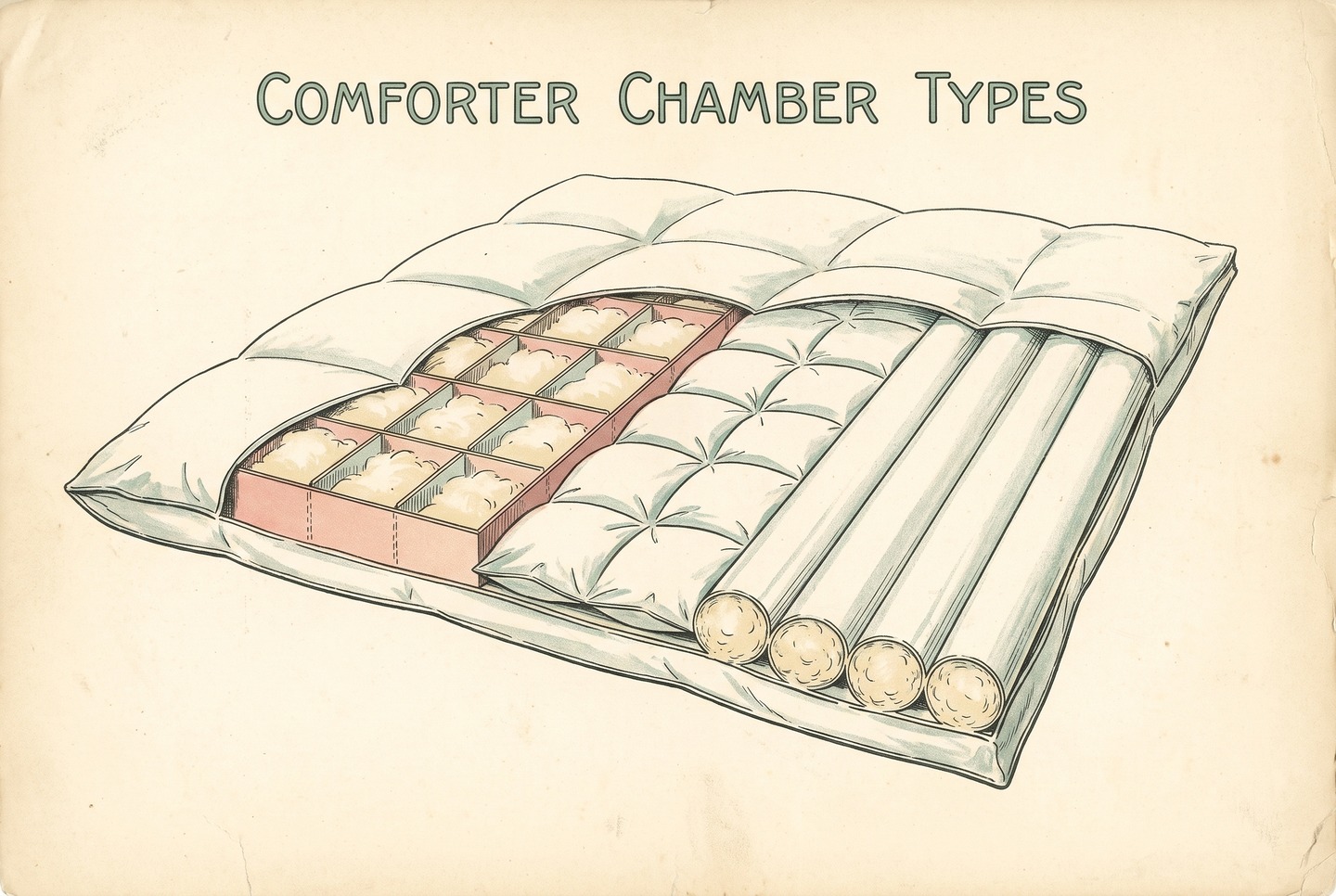
The way a comforter is sewn decides where its fill sits and where your body heat slips out. Product pages use the three names loosely. This page shows you what each one looks like inside. It also covers where research ranks construction among the things that keep you warm, and why cotton fill follows different rules from down.
Short answer: A baffle box comforter has fabric walls between its top and bottom layers, so the fill keeps its full height all the way to the seam. A sewn-through comforter stitches the two layers together. That pinches the fill and lets more heat out along every seam. Channel construction uses long tubes, and the fill can drift to one end. A heat-transfer model (Zheng et al., 2025) ranked fill power and fill weight ahead of stitch density, so look at the fill first and the construction second.
This guide is for: anyone comparing comforters or duvet inserts who sees baffle box, box stitch, or channel on a product page and wants to know what the word changes.
Key Takeaways
Three findings carry most of this page: where heat escapes, what ranks above construction, and what cotton comforter pages say they use.
- Heat leaves at the stitch lines. A 3D model of a down quilt found temperature and heat flux highest at the quilting stitches. About 30% of the heat lost from the surface went by convection and about 70% by radiation (Zheng et al., 2025). Every seam you see on a sewn-through comforter is one of those lines.
- Fill ranks above construction. The same model ranked fill power and fill weight ahead of stitch density. A separate hot-plate study built 20 down samples from four stitch spacings and five fill weights to test how the two work together (Liu et al., 2025).
- Cotton comforter pages lean sewn-through. Our count covered 13 seller pages. Of those, 6 named sewn-through, quilted, or box stitching, 4 named baffle box, and 3 named no construction or contradicted themselves. None of the 5 pages with cotton fill named baffle box alone.
On This Page
Eight sections, each answering one question, in the order most people need them: the build first, then warmth, cotton, and how to check.
What is the difference between baffle box, sewn-through, and channel construction?
All three hold fill in pockets. They differ in whether fabric walls separate the layers and whether the pockets are squares or long tubes.
Every comforter is two layers of fabric with fill between them, and loose fill would slide to the edges. So makers divide the shell into pockets. How they divide it is the construction.
Sewn-through stitches the top layer straight to the bottom one. Baffle box sews a narrow strip of fabric, called the baffle, between the two layers so they never touch. Channel is a different kind of word. It names the shape of the pocket, not the way it is stitched. A channel comforter has parallel channels of fill running its length (eachnight), and those rows can be sewn through or baffled.
The table below is our judgement of how each build works. No maker publishes this table.
| Sewn-through | Baffle box | Channel | |
|---|---|---|---|
| What joins the layers | Stitching straight through both | A fabric wall between them | Either one, in long rows |
| Pocket shape | Squares or diamonds | Squares or rectangles | Tubes running one way |
| Fill at each seam | Thins to almost nothing | Full height | Depends on how the rows are joined |
| Fill movement | Stays in its pocket | Stays in its box | Can travel along the tube |
| Heat at the seams | Leaks along every stitch line | Held back by the wall | Leaks only if the rows are sewn through |
| Our read on fit | Batting fills, warm rooms, people who run hot | Down at higher fill weights, cold rooms | People who like to move the fill around |
How is a baffle box comforter built?
Thin fabric walls stand between the top and bottom layers, so each box is a small room and the fill keeps its full height right up to the seam.
In a baffle box comforter, thin upright strips of fabric join the top and bottom layers. Each pocket becomes a small box with walls, a floor, and a ceiling. Nothing pinches the seam. So the fill can rise to its full height right to the edge of each box.
One maker's product page says its small fabric walls let its 700+ fill power goose down expand fully without shifting or leaving cold spots (Feathered Friends). The build is not always complete. A US maker says the outer ring of boxes in its summer-weight baffle box comforter has no sidewall, while every interior box is baffled (Vero Linens). Ask about the edges if you run cold.
Baffle boxes pay off most when you have a lot of down. Box sizes and fill amounts vary widely. One midweight goose down comforter in the 88 by 98 inch size holds 35 oz of 600-fill down under a 280-thread-count cotton cover (L.L.Bean). An organic cotton comforter lists 13 by 13 inch baffle boxes holding 600 GSM of synthetic fill (Organic Favorite).
You pay extra for the added fabric and sewing. Baffle box comforters usually cost more to make and to buy than sewn-through ones (eachnight). The walls are what you pay for. They only earn their cost when there is enough fill to press against them.
How is a sewn-through comforter built?
The top and bottom fabric are stitched straight together, so each pocket pinches to almost nothing at its seams and heat leaks along those lines.
A sewn-through comforter has no walls. The top and bottom fabric are stitched straight together in a grid, in diamonds, or in rows. At each stitch line, you lose almost all of the fill's height.
That is where heat escapes. A 3D model of a down quilt tested on a heated plate found temperature and heat flux highest at the quilting stitches (Zheng et al., 2025). The stitches also lost more heat by radiation than the thickest parts of the quilt did.
That may not be a flaw for you. One organic cotton down comforter uses sewn-through construction to keep the fill in place and give a lighter, more breathable feel (Puredown). If you sleep hot, that kind of build suits you. A retail organic cotton comforter uses 14 inch sew-through boxes, and its 90 by 98 inch queen holds 2.88 lbs of polyester fill (Costco).
Pocket size and fill weight work together. A hot-plate study made 20 down samples from four stitch spacings and five fill weights (Liu et al., 2025). Its review of earlier work notes that some studies found stitch spacing second only to fill amount in its effect on warmth (Liu et al.). Our judgement is that wider spacing gives the fill more room to rise between the stitch lines, while narrower spacing holds loose fill in place better. For cotton, our guide to why cotton duvets shift gives the spacing limits batting makers print.
What is channel construction, and why does the fill shift?
Channels are long tubes running head to foot or side to side. Fill can travel along each tube, which lets you move warmth but also lets it drift.
Channels are long pockets that stay open along their length. In a channel comforter, the fill sits in parallel rows that run the length of the comforter (eachnight). That openness cuts both ways.
The upside is control. You can shake fill toward your feet on a cold night, then spread it back out when the room warms up. The downside is drift. Nothing stops the fill from sliding to the ends of each tube. After years of use and washing, you may find the middle of each row has thinned out.
Makers treat this as a known problem. One US patent describes a comforter or featherbed that places baffles inside its side-by-side channels (Google Patents). The patent names shifting of loose fill such as down as a key concern, because it hurts both how the comforter performs and how it looks.
The names also blur on product pages. One goose down comforter listing describes a "baffle channel design" and, further down the same page, a baffle box with invisible seams (Pillows.com). If the shape matters to you, look at a photo of the seams or ask the seller which way the rows run. In the count further down this page, you will not find a cotton comforter page that used channel as its main label.
Does construction matter more than fill weight for warmth?
No. Research on down quilts ranks fill power and fill weight first. Stitch density comes after them, and the shell fabric matters least of all.
No. You can see the order in the research. A study that varied one factor at a time found fill power and fill weight had the most effect on a down quilt's warmth. Stitch density came next, and the shell fabric mattered least (Zheng et al.).
Fill weight has limits too. A study using a heated body-shaped test dummy found warmth rose with fill weight, but more slowly as fill was added. If you lie on your back with your arms outside the quilt, the study found no gain above 600 g, or about 21 oz (Lu et al.).
Your bedroom sets the warmth you need. A sleep-lab study used six duvets rated from 3.81 to 8.93 clo, a unit of insulation. The warmest was comfortable from 8.2 to 17.7 °C, and the lightest from 16.4 to 22.2 °C (PubMed). That is roughly 47 to 64 °F for the warmest and 62 to 72 °F for the lightest.
Fill power is a lab number. The official test fills a cylinder with 30 g of down and feathers and reports the result in cubic inches per 30 g (IDFB Testing Regulations). Typical values run from 300 to 900 (IDFL test summary). You won't find a fill power rating on cotton or polyester. Choose your warmth by fill weight and fill type first, then use construction to fine-tune it. Our guide to what makes a lightweight cotton comforter light works through the same steps.
Which construction suits a cotton-filled comforter?
Sewn-through, nearly always. Cotton batting is a sheet that the stitching holds flat, not loose clusters that need walls to stand up in a box.
Cotton batting behaves like a sheet, not like loose clusters. Researchers who model down quilts point out that cotton, wool, silk, and synthetic fills can form a layer of set thickness on their own. Down cannot, so it has to be held inside fabric pockets (Zheng et al.). A baffle box is one of those pockets. Cotton does not need it.
A US patent on quilted materials draws the same line. Down behaves like a fluid, so the shape of a down pocket matters mainly for how much it holds. In a fiber-filled product, the stitching method plays a very important role in how warm it is (US Patent 8,802,218). With batting, the stitching is what keeps the layer flat and even.
The cotton-filled pages we read match this. One comforter pairs organic cotton batting with a quilting pattern that keeps the fill in place (Soaring Heart). Another comforter, made entirely of cotton, lists box stitch construction (Crane & Canopy).
Watch for a baffle box "cotton comforter" where you get cotton only in the shell. One seller says it chose synthetic fill over cotton because cotton-filled quilts can be very heavy, and it puts that fill in baffle boxes (Organic Favorite). The choice makes sense for weight. Still, you are not buying cotton inside. You can check the fill line with our page on whether a 100% cotton comforter is cotton inside, too, and compare fill weights with the guide to what is inside a cotton duvet insert.
What do product pages say about construction?
Of 13 seller pages for cotton comforters, most named a construction, but 3 named none or used two contradictory terms on the same page.
We read 13 seller product pages for comforters with a cotton shell or cotton fill on September 26, 2026, and sorted each one by the construction it names. The table reports claims as printed. The comforters in our picks were bought and handled, but none was cut open or measured for it.
| What the page names | Pages | Pages in this group |
|---|---|---|
| Baffle box only | 4 | L.L.Bean, Organic Favorite, Down To Basics, Egyptian cotton listing on Amazon |
| Sewn-through, quilted, or box stitch only | 6 | Soaring Heart, Puredown all-season, Puredown lightweight, Farm to Home at Costco, Crane & Canopy, Schweitzer Linen |
| No construction named, or two terms that contradict | 3 | Quahog Bay, Amazon cotton-fill listing, Amazon cotton set listing |
| Total | 13 |
Three things stood out. First, the third group is not empty. One listing calls its cotton-fill comforter box stitched in the title, then calls it a baffle box comforter in the description (Amazon). Another cotton listing uses both "box stitched" and "baffle-box construction" for the same comforter (Amazon).
Second, 5 of the 13 pages were for comforters with cotton fill. Of those, 3 named sewn-through or box stitching and 2 fell in the third group. None named baffle box alone. Third, none of the 13 used channel as its main label.
So when you read a label, treat it as a claim, not a guarantee. When a page uses two terms, you should trust the photo of the seams over either word.
How do you check the construction before you buy?
Look at the seams, not the name. Pinched seams mean sewn-through, and a flat strip of fabric inside a seam means a baffle, whatever the label says.

You can start with the listing, then study the seams. The table below is our checklist. You will not find it laid out this way on a seller's page.
| Check | What it tells you | Where to look |
|---|---|---|
| Fill material, listed separately from the shell | Whether "cotton comforter" means cotton inside | Materials or specs line |
| Fill weight in ounces for your size | How warm it is, which matters more than construction | Size chart |
| Fill power, for down only | How much space each ounce of down fills | Specs line |
| Close-up photo of a seam | Pinched seams mean sewn-through; a flat fabric strip means baffles | Product images |
| Box or channel size in inches | Smaller pockets hold the fill more tightly | Specs or description |
| Edge boxes | Whether the outer ring of boxes has walls | Ask the seller |
Seams tell you more than names. On a sewn-through comforter, each seam dips to a thin line you can pinch between two fingers. On a baffled comforter, the seam stays full. You can feel a narrow fabric wall inside it. If you run hot, a sewn-through build lets heat out by design. If you run cold under down, a baffle box keeps more heat in once the fill weight is right.
Size changes the numbers too. A king with the same ounces as a queen is thinner. One goose down line steps its fill from 26 oz in a twin to 34 oz in a queen and 40 oz in a king (Pillows.com), so you get roughly even fill per square foot.
Common questions
Short answers to the questions people often ask about comforter construction, with the source for each figure linked in the answer itself.
Is baffle box warmer than sewn-through?
With the same fill, usually yes. Stitch lines leak heat. A 3D model found temperature and heat flux highest at the quilting stitches (Zheng et al.). Fill weight still matters more than the build, so compare ounces before you compare construction.
What does box stitch mean?
It is a sewn-through comforter stitched in a grid of squares, not a baffle box. One retail comforter describes its 14 inch sew-through box construction (Costco). If a page says both box stitch and baffle box, ask the seller which one you are getting.
Can a cotton-filled comforter be baffle box?
It can, but you will rarely see one. Cotton batting holds its own thickness. So makers quilt it straight through. In our count of 13 pages, none of the 5 cotton-filled comforters named baffle box alone.
Why does fill collect at the end of a channel comforter?
The tubes are open along their whole length, so nothing holds the fill in the middle. Keeping loose fill from shifting in use is a known design problem that patents try to solve (see this US patent). Shake the fill back along each tube after you wash it.
Does fill power apply to cotton?
No. Fill power is a test for down. The official test fills a cylinder with 30 g of down and feathers and reports cubic inches per 30 g (IDFB Testing Regulations). You judge a cotton comforter by its fill weight instead.
Is sewn-through construction a sign of low quality?
No. It is simpler to make, and it suits batting and warm rooms. One organic cotton down comforter picks sewn-through construction on purpose for a lighter, more breathable feel (Puredown). The right build depends on your fill and your room.
Sources
Reading list for this cotton duvet piece, each title paired with the section where it does its work.
- Zheng et al., 2025 (sciencedirect.com), at work in “Key Takeaways”; “How is a sewn-through comforter built?”; “Does construction matter more than fill weight for warmth?”; “Which construction suits a cotton-filled comforter?”; “Common questions”.
- Liu et al., 2025 (global-sci.com), at work in “Key Takeaways”; “How is a sewn-through comforter built?”.
- eachnight (eachnight.com), at work in “What is the difference between baffle box, sewn-through, and channel construction?”; “How is a baffle box comforter built?”; “What is channel construction, and why does the fill shift?”.
- Feathered Friends (featheredfriends.com), at work in “How is a baffle box comforter built?”.
- Vero Linens (verolinens.com), at work in “How is a baffle box comforter built?”.
- L.L.Bean (llbean.com), at work in “How is a baffle box comforter built?”; “What do product pages say about construction?”.
- Organic Favorite (organicfavorite.com), at work in “How is a baffle box comforter built?”; “Which construction suits a cotton-filled comforter?”; “What do product pages say about construction?”.
- Puredown (puredown.com), at work in “How is a sewn-through comforter built?”; “What do product pages say about construction?”; “Common questions”.
- Costco (costco.com), at work in “How is a sewn-through comforter built?”; “What do product pages say about construction?”; “Common questions”.
- Liu et al. (global-sci.com), at work in “How is a sewn-through comforter built?”.
- Google Patents (patents.google.com), at work in “What is channel construction, and why does the fill shift?”; “Common questions”.
- Pillows.com (pillows.com), at work in “What is channel construction, and why does the fill shift?”; “How do you check the construction before you buy?”.
- Lu et al. (sciencedirect.com), at work in “Does construction matter more than fill weight for warmth?”.
- PubMed (pubmed.ncbi.nlm.nih.gov), at work in “Does construction matter more than fill weight for warmth?”.
- IDFB Testing Regulations (cfd.com.cn), at work in “Does construction matter more than fill weight for warmth?”; “Common questions”.
- IDFL test summary (alliedfeather.com), at work in “Does construction matter more than fill weight for warmth?”.
- US Patent 8,802,218 (image-ppubs.uspto.gov), at work in “Which construction suits a cotton-filled comforter?”.
- Soaring Heart (soaringheart.com), at work in “Which construction suits a cotton-filled comforter?”; “What do product pages say about construction?”.
- Crane & Canopy (craneandcanopy.com), at work in “Which construction suits a cotton-filled comforter?”; “What do product pages say about construction?”.
- Down To Basics (downtobasics.com), at work in “What do product pages say about construction?”.
- Egyptian cotton listing on Amazon (amazon.com), at work in “What do product pages say about construction?”.
- Puredown lightweight (puredown.com), at work in “What do product pages say about construction?”.
- Schweitzer Linen (schweitzerlinen.com), at work in “What do product pages say about construction?”.
- Quahog Bay (quahogbaybedding.com), at work in “What do product pages say about construction?”.
- Amazon cotton-fill listing (amazon.com), at work in “What do product pages say about construction?”.
- Amazon cotton set listing (amazon.com), at work in “What do product pages say about construction?”.