Why do cotton duvets shift, and what construction prevents it?
Updated .
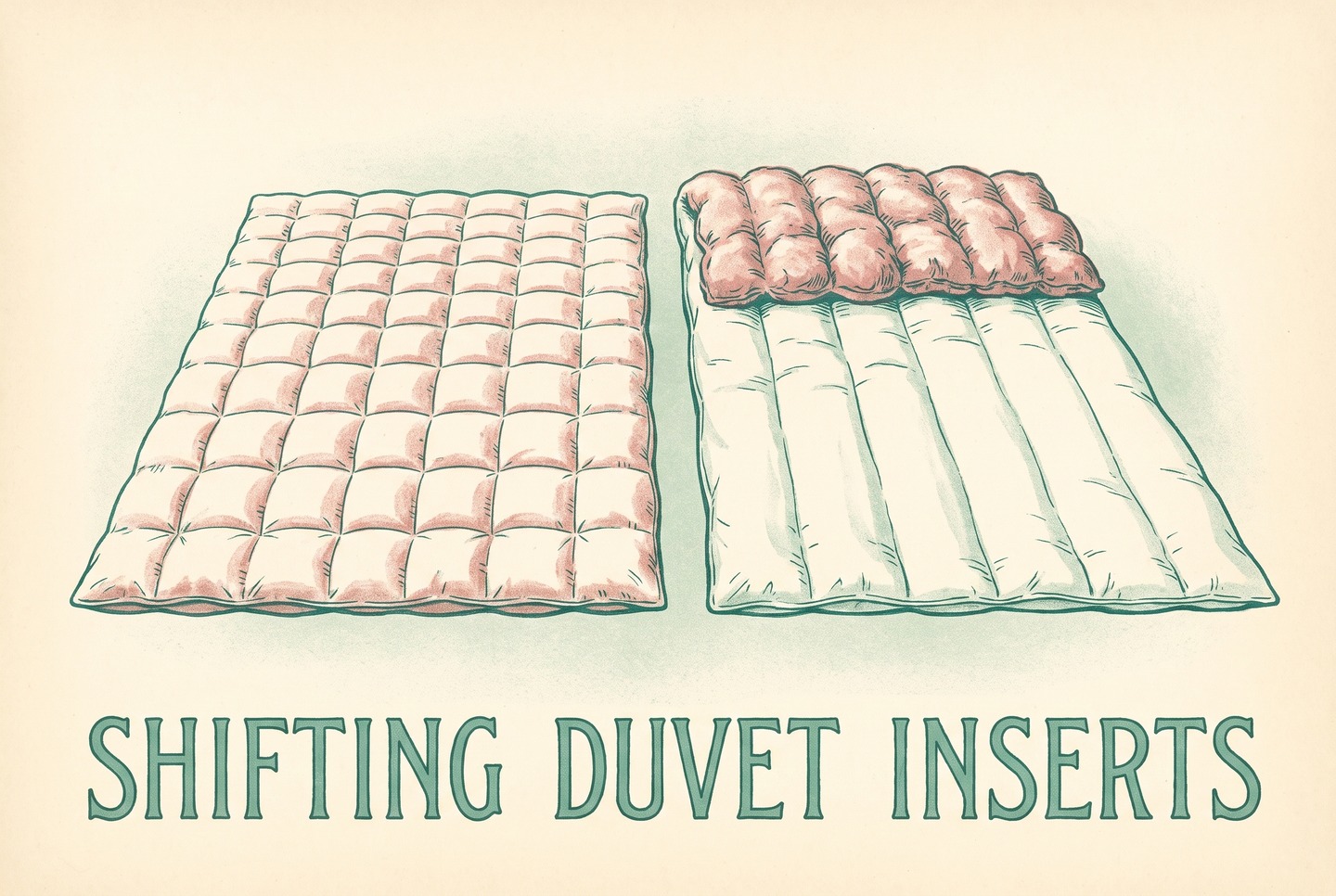
Your cotton duvet can start out flat and end up with thick ridges along one edge and thin patches where your shoulders go. You could be looking at either of two faults, and each one has its own fix. This guide explains both, then shows what to check in the stitching before you buy. The figures come from batting makers, patents, lab studies, a federal agency and sellers' own product pages.
Short answer: Cotton fill shifts because loose cotton fibers don't grip each other or spring back, so body weight and washing push them into clumps. The construction that prevents it is small, evenly spaced pockets. One batting maker rates its scrim-backed cotton for stitch lines up to 10 inches apart (The Warm Company listing). Cotton without scrim needs 3 to 4 inches (Freshly Pieced). If the whole insert slides around instead, tie all four corners.
This guide is for: people whose cotton-filled duvet or comforter has gone lumpy, and people buying one who want it to stay even.
Key Takeaways
You only need to check three things: the size of each pocket, the batting inside it, and how the insert is tied to its cover.
- Pocket size decides how far fill can move. Cotton needled through a scrim can be stitched up to 10 inches apart (The Warm Company listing). Cotton without scrim needs lines every 3 to 4 inches (Freshly Pieced).
- Stitch lines cost a little warmth. A patent on quilted down fabric spaces its lines about 6 inches apart to limit cold spots at the seams (USPTO patent).
- Sellers rarely give you the number. We read 6 product pages for cotton-filled bedding on 2026-09-27, and only 1 of them stated a stitch spacing.
On This Page
You can jump to any of the eight sections below, from why cotton fill moves, through stitch spacing and warmth, to keeping an insert still in its cover.
Why does the fill in a cotton duvet shift?
Cotton fibers do not spring back or grip each other well, so body weight, washing and turning push loose fill into the low spots.
Cotton fill comes in two forms. Some duvets hold loose carded cotton, which is a fluffy mass of separate fibers. Others hold batting, where the fibers have been pressed or needled into a mat. Either way, friction does most of the work of keeping the fibers in place. Friction gives way under repeated pressure.
Cotton also has little spring. One fiber reference puts cotton's elastic recovery at 74% after a 2% stretch and 45% after a 5% stretch, and calls the fiber rigid and inelastic (Textile School). In plain terms, cotton that you push out of place tends to stay there.
Three forces do the pushing. You press fill away from wherever you lie. Each time you turn over, you drag it toward the edges. Washing is the hardest test. Wet fibers tumble freely and pull apart in the drum. One quilting reference says the bumpy feel of antique cotton quilts comes from the cotton breaking apart in the wash (Learn How to Quilt).
So you shouldn't ask whether cotton fill will try to move. It will. The useful question is how far the construction lets it travel before it runs into a seam. Most of the rest of this guide is about that distance, and about how to find it on a product before you pay.
Is the fill moving, or is the whole insert sliding in the cover?
Two different faults look alike: fill migrating inside its own shell, and a whole insert sliding around inside a loose cover.
Before you blame the stitching, check which fault you have. Take the cover off and lay the insert flat on the bed.
If you see thick and thin areas in the insert itself, the fill has migrated inside its shell. That comes down to construction or washing, and it's what most of this guide covers. If the insert looks even but you keep finding it in a heap at the foot of the bed, the insert is sliding inside the cover. The fill is fine in that case. The cover is loose, untied, or both.
| What you see | Which fault | Where the fix lives |
|---|---|---|
| Ridges of fill along seams or one edge, thin patches between | Fill migrating inside the shell | Stitch pattern, spacing, and how you dry it |
| Empty corners on the cover, insert bunched at one end | Insert sliding in the cover | Corner and side ties, and cover size |
| Both at once | Usually sliding first, then fill packed down by the bunching | Tie the insert, then work the fill back by hand |
The third row is our judgement, not a measured result. An insert that bunches every night gets folded and pressed in the same places, and that is the same kind of pressure that moves loose fill. If you only have the second problem, you can skip ahead to the section on stopping an insert from sliding. You don't need a new duvet for it.
How does stitching keep cotton fill in place?
Stitch lines join the top and bottom fabric through the fill, cutting the duvet into pockets so fill can only travel as far as a wall.
A duvet shell is two layers of fabric. When stitching goes straight through both layers with the fill in between, the build is called sewn-through. Each line of stitches you see is a wall the fill can't cross.
A 2025 study describes sewn-through as one of the most common ways to make insulated goods, because it is simple and cost-effective (Textiles, 2025). The cost is warmth. A peer-reviewed paper on stitching explains that ordinary sewing compresses the material where the needle goes in (Applied Composite Materials).
Pocket size matters more than the pattern. A patent on down duvet covers describes what happens when stitch lines are spaced too far apart. The fill gathers into clusters, other areas are left with little or none, and the warmth ends up uneven (USPTO patent). That patent is about down. In our reading, you'd see loose cotton in a large pocket fail the same way, with even less spring to recover.
Baffle box construction adds thin fabric walls between the top and bottom layers. That gives each pocket some height and keeps the seams from pinching the fill flat. If you want a side-by-side of the three main layouts, see how baffle box, sewn-through, and channel comforters differ.
Two other parts of the build help. A scrim inside the batting holds the fibers together between the stitch lines. A firmly sewn edge keeps fill from working its way out into the piping.
How far apart should the stitching be on a cotton duvet?
Batting makers allow 8 to 10 inches with a scrim, but loose cotton needs lines every few inches, and a duvet washed often needs them closer.
You'll find the most useful numbers on quilt batting, because makers print a maximum stitch distance on the package (Generations Quilt Patterns).
| Batting inside | Stated maximum distance between stitch lines | Source |
|---|---|---|
| Cotton needled through a scrim | Up to 10 inches | The Warm Company listing |
| Cotton with a scrim, general range | 8 to 12 inches | Freshly Pieced |
| Cotton without a scrim | 3 to 4 inches | Freshly Pieced |
| Cotton without a scrim, stricter guide | 1/2 to 1 inch | Learn How to Quilt |
Two cautions apply. First, these are maximums for quilts, and quilts are thinner than most duvet inserts. One editor advises stitching closer than the package figure if a quilt will be washed or heavily used (Generations Quilt Patterns). A duvet gets both.
Second, the scrim is often not cotton. The same quilting reference warns that batting sold as 100% cotton but rated for stitching 2 or more inches apart may not be all cotton (Learn How to Quilt). US rules require the fiber of any filling used for warmth to be disclosed separately (16 CFR 303.22; FTC), so you can check the fill line on the label.
Our judgement for a cotton duvet you plan to wash: pockets no wider than about 10 inches if the batting has a scrim, and 4 inches or less if the seller doesn't say. If you're choosing a weight, the guide to duvet fill weight in ounces and GSM explains how each one shows up on the bed.
Which construction keeps cotton fill from shifting?
Small sewn-through boxes suit thin cotton fill, baffle walls suit thick fill, and wide channels let cotton slide toward the ends.
| Construction | How it holds fill | Shift risk with cotton fill (our judgement) | Trade-off |
|---|---|---|---|
| Sewn-through box, 10 inches or smaller | Fill locked into square pockets | Low | Thin, cooler line at every seam |
| Diamond quilting | Works like boxes, set at an angle | Low to medium, depending on size | Size is rarely given on product pages |
| Channel, stitched lengthwise | Walls on two sides only | Medium to high: fill can run along the channel | Clean look, easy to sew |
| Baffle box | Fabric walls give each pocket height | Low | More fabric and labor, mainly worth it for thick fill |
| Tied or tufted, edges stitched | A few tie points hold the batting | High for loose fill, lower for needled batting | Soft drape |
No maker publishes this table. It is our reading of how each layout holds fill back, based on the spacing figures and the patent and study findings cited in this guide. You should read "low" as a comparison between layouts, not a test score.
Channels need a note. Many cotton quilts use them. A channel stops fill moving across the bed but not along it. That's fine for batting needled onto a scrim, since it barely travels anyway. It's riskier with loose fill, which can slide down a long channel toward your feet.
Narrow channels reduce the risk. One quilt with organic cotton batting uses a 1-inch channel stitch (Saatva product page; batting listed on Amazon). When you compare two channel-stitched duvets, the channel width tells you more than the fabric does.
Do more stitch lines make a cotton duvet colder?
Yes, a little. Each stitch line squeezes the fill flat, and research on quilted bedding finds heat escapes fastest along those lines.
Warmth is why makers don't stitch every inch. A patent on quilted down fabric explains that fill along stitched lines is highly compressed and gives little insulation there. It recommends spacing the lines about 6 inches apart to reduce these cold spots (USPTO patent). A second patent adds another cause: the needle holes along each seam let more air through (USPTO patent).
Lab work points the same way. A heat-transfer model of a down quilt found temperature and heat flux were highest at the quilting stitches. It ranked fill power and fill weight as the largest factors, followed by quilting density (ScienceDirect, 2024). A study of down clothing found heat resistance rose as the number of quilted sections fell, with smaller gains at higher counts (Textile Research Journal, 2023).
All of this research used down, not cotton. The logic carries over, but we found no published figure for how big the effect is with cotton fill.
Here is what that means for you. You're trading even fill against warmth along the seams. Fill weight matters more than either one. If a cotton duvet feels cool along its seams, a slightly heavier fill does more for you than wider pockets that let the cotton drift.
What do sellers say about stitch spacing on cotton duvets?
We read six cotton-filled product pages. Only one gave a stitch spacing; three named a pattern without a size, and two named neither.
Our count: on 2026-09-27 we read 6 product pages for cotton-filled duvets, comforters and quilts sold in the United States, and recorded only what each page says about its stitching. We counted statements on the pages. We did not handle, weigh or test any product.
| What the page states | Pages | Which pages |
|---|---|---|
| A stitch pattern and a spacing | 1 | 1-inch channels (Saatva) |
| A stitch pattern, no spacing | 3 | "Linear" stitching (Quince stripe quilt); diamond (Whisper Organics); diamond (Coyuchi) |
| No pattern or spacing | 2 | Quince hand-stitched quilt; Delara insert |
Most of these pages say the stitching keeps the fill even. Only one gives you a number you could check.
Down-filled inserts make a useful contrast. One down insert with an organic cotton shell lists its construction as a 12-inch sewn-through box (The Clean Bedroom listing). That is exactly the figure you can't get from the cotton-fill pages.
If a page doesn't state the spacing, ask the seller before you buy. You can also lay a tape measure across one pocket when the duvet arrives, before the first wash, while returning it is still easy. Compare what you find with the spacing table above.
How do you stop a duvet insert sliding inside its cover?
Tie the insert to the cover at every corner, add side ties if both pieces have them, and match the cover size to the insert size.
A sliding insert has nothing to do with the fill. More stitching won't fix it. Your insert moves because it isn't tied to the cover.
Tie all four corners. Many inserts have a loop or tab at each corner, and many covers have matching ties inside. Two pages in our count mention them: one comforter has corner tabs (Whisper Organics), and another has corner loops (Coyuchi). If you only tie two corners, the loose end still drifts.
Add side ties if you can. Four corners still leave the long edges free to fold over. Some inserts have more anchor points. One insert with an organic cotton shell lists 8 reinforced corner and side tabs (Bed Bath & Beyond product page).
Match the sizes. A cover bigger than its insert leaves empty fabric at the corners, and the insert has room to slide into it. When you buy, compare the insert's listed dimensions with the cover's, not just the bed size on the label. The guide to what size duvet you need and how much overhang you get works through the numbers for each bed.
If your insert has no loops, you can use duvet clips. Duvet clips are a stopgap. In our judgement they work less well than ties. They grip at only a few points, so your insert can still shift in the gaps between them.
Common questions
Short answers to the questions people ask most about cotton duvet fill, washing, scrim, corner ties and covers that fit too loosely.
Does washing make cotton fill shift?
Yes, more than anything else does. Wet fibers tumble and separate, which is why stitch-spacing advice for cotton batting without scrim is so strict. You should dry the duvet fully on low heat. One batting listing notes up to 3% shrinkage on the first cold wash (The Warm Company listing).
Will shaking a cotton duvet fix clumps?
Shaking helps when loose fill has drifted only a short way. It does little for batting that has torn or matted, because cotton has low spring. Pull the clumps apart by hand and work them back toward the thin areas before you shake.
Is baffle box worth it for a cotton duvet?
Mostly for thick fill. Baffle walls give each pocket height and avoid pinched seams. If your cotton batting is thin, you gain less from them, because a small sewn-through box already holds it well.
What is scrim, and is it still 100% cotton?
Scrim is a thin mesh needled into batting to hold the fibers together. It is often synthetic. If a page says 100% cotton but allows wide stitch spacing, ask the seller what the scrim is made of.
How many corner ties should a duvet insert have?
At least four, one per corner. You should tie all of them. Inserts with side tabs as well hold the long edges too. One listing has 8 in total.
Can a cover that is too big cause shifting?
Yes. Extra length and width leave empty fabric at the corners, and the insert slides into it. Choose a cover whose listed size matches the insert's, or is slightly smaller.
Sources
Reading list for this cotton duvet piece, each title paired with the section where it does its work.
- The Warm Company listing (amazon.com), at work in “Key Takeaways”; “How far apart should the stitching be on a cotton duvet?”; “Common questions”.
- Freshly Pieced (freshlypieced.com), at work in “Key Takeaways”; “How far apart should the stitching be on a cotton duvet?”.
- USPTO patent (image-ppubs.uspto.gov), at work in “Key Takeaways”; “Do more stitch lines make a cotton duvet colder?”.
- Textile School (textileschool.com), at work in “Why does the fill in a cotton duvet shift?”.
- Learn How to Quilt (learnhowtoquilt.com), at work in “Why does the fill in a cotton duvet shift?”; “How far apart should the stitching be on a cotton duvet?”.
- Textiles, 2025 (doi.org), at work in “How does stitching keep cotton fill in place?”.
- Applied Composite Materials (link.springer.com), at work in “How does stitching keep cotton fill in place?”.
- USPTO patent (image-ppubs.uspto.gov), at work in “How does stitching keep cotton fill in place?”.
- Generations Quilt Patterns (generations-quilt-patterns.com), at work in “How far apart should the stitching be on a cotton duvet?”.
- 16 CFR 303.22 (ecfr.gov), at work in “How far apart should the stitching be on a cotton duvet?”.
- FTC (ftc.gov), at work in “How far apart should the stitching be on a cotton duvet?”.
- Saatva product page (saatva.com), at work in “Which construction keeps cotton fill from shifting?”; “What do sellers say about stitch spacing on cotton duvets?”.
- Amazon (amazon.com), at work in “Which construction keeps cotton fill from shifting?”.
- USPTO patent (image-ppubs.uspto.gov), at work in “Do more stitch lines make a cotton duvet colder?”.
- ScienceDirect, 2024 (sciencedirect.com), at work in “Do more stitch lines make a cotton duvet colder?”.
- Textile Research Journal, 2023 (journals.sagepub.com), at work in “Do more stitch lines make a cotton duvet colder?”.
- Quince stripe quilt (quince.com), at work in “What do sellers say about stitch spacing on cotton duvets?”.
- Whisper Organics (whisper-organics.com), at work in “What do sellers say about stitch spacing on cotton duvets?”; “How do you stop a duvet insert sliding inside its cover?”.
- Coyuchi (coyuchi.com), at work in “What do sellers say about stitch spacing on cotton duvets?”; “How do you stop a duvet insert sliding inside its cover?”.
- Quince hand-stitched quilt (quince.com), at work in “What do sellers say about stitch spacing on cotton duvets?”.
- Delara insert (delarahome.com), at work in “What do sellers say about stitch spacing on cotton duvets?”.
- The Clean Bedroom listing (thecleanbedroom.com), at work in “What do sellers say about stitch spacing on cotton duvets?”.
- Bed Bath & Beyond product page (bedbathandbeyond.com), at work in “How do you stop a duvet insert sliding inside its cover?”.